Voice fraud is no longer a minor operational risk. It has become a full-scale enterprise crisis, and at NetworthOra, we break down exactly how the Agentic AI Pindrop Anonybit framework stands as the most advanced three-layer defense architecture built specifically to stop it. Contact centers are hit by fraud attempts every 46 seconds. Deepfake audio attacks surged by 1,300% over the past year. Biometric databases have become prime targets for cybercriminals who know that a stolen voiceprint, unlike a stolen password, can never be reset or reissued. The rules of identity security have fundamentally changed, and organizations that continue relying on static defenses are leaving themselves dangerously exposed.
This guide breaks down exactly how the Agentic AI Pindrop Anonybit stack works, why each layer matters, and what real-world deployments look like when all three components operate together.
Why Traditional Security Models Are Failing Against Modern Fraud

For decades, organizations built their security posture around a simple assumption: attackers are human, they work at human speed, and they can be stopped with credentials. That assumption is now obsolete.
Traditional security architectures rely on static defenses. Passwords, security questions, and SMS-based one-time passcodes were designed for a world where fraudsters needed time, skill, and human effort to execute an attack. Knowledge-based authentication questions like your mother’s maiden name or your first childhood address are now freely available on dark web marketplaces for a few dollars. SMS-based two-factor authentication is increasingly vulnerable to SIM swap attacks, which increased by 400% between 2020 and 2023 according to FBI data.
The core structural flaw in legacy systems is not a lack of data. It is a lack of intelligence. These systems collect signals but cannot reason about them in real time, adapt to new attack patterns autonomously, or act fast enough to stop fraud while it is happening. They treat authentication as a single gate rather than a continuous process.
Modern adversaries have exploited this gap completely. AI-powered voice cloning tools can replicate a person’s voice from as little as 30 seconds of recorded audio. Agentic AI fraud systems can initiate thousands of calls simultaneously at 3 a.m., navigate IVR menus, answer knowledge-based authentication questions using stolen PII, and adapt their conversational tone mid-call without a single human attacker ever involved. Fraud losses in U.S. contact centers reached an estimated $12.5 billion in 2024 alone.
The organizations absorbing the most damage are those still running defenses built for human-speed threats against machine-speed attacks. The gap between what legacy systems can detect and what modern fraudsters can execute is widening every year.
What Agentic AI Actually Means for Fraud Prevention

The term artificial intelligence is applied so broadly that it risks losing meaning. When most security vendors say they use AI, they mean a machine learning model that scores transactions or classifies inputs based on patterns from training data. That is reactive and narrow.
Agentic AI is fundamentally different. An AI agent does not simply classify an input and return a score. It reasons, plans, executes multi-step workflows, monitors outcomes, and adjusts its behavior based on what it observes. In fraud prevention, this distinction is the difference between a system that flags something suspicious after a transaction completes and a system that blocks the attack before it reaches a human agent.
How Agentic AI Operates in Security Contexts
Agentic AI systems in security environments have several defining characteristics that separate them from conventional AI tools.
Autonomy is the most critical. Agents operate independently within defined parameters, executing decisions without waiting for human approval at each step. In fraud prevention, the gap between detection and human review is precisely where attacks succeed. An automated system that detects a suspicious call and routes it to a human queue for review might take minutes to reach a decision. An agentic system makes that decision in milliseconds, before the fraudster has reached a live agent.
Multi-modal reasoning allows agents to process and correlate signals from voice, device metadata, behavioral patterns, network telemetry, and transaction history simultaneously. No single signal is conclusive on its own. A slightly unusual call routing pattern might be meaningless in isolation. Combined with a voice liveness score below threshold and a biometric match failure, it becomes grounds for an immediate block.
Goal-directed behavior means agents pursue defined objectives and adapt their approach based on context. An agentic fraud prevention system is not running a fixed rulebook. It is continuously reasoning about whether the current interaction is consistent with legitimate behavior for this account, this device, this time of day, and this type of transaction.
According to research from 2025, organizations deploying agentic AI in fraud prevention workflows saw incident response times cut by more than 50% compared to rule-based setups, with false positive rates dropping significantly as well.
The Attack Surface Created by Agentic AI Itself
The same autonomy that makes agentic AI useful in defense also makes it a dangerous weapon in the hands of attackers. A fraudster deploying their own agentic AI system with a goal of accessing a specific account does not guess credentials one at a time. The attacking agent scans public profiles to clone a voice from a conference recording, calls the bank’s support line, works through IVR menus, and argues with human staff using realistic urgency, all without any human operator involved.
Against a human defender, the attacking agent is faster, more consistent, and never sleeps. Pindrop’s data shows AI-driven fraud attempts surged 1,210% in 2025, while traditional fraud grew just 195% over the same period. Organizations relying on knowledge-based authentication are defending a locked front door while the window beside it is wide open.
The right response is not simply to add another rule to an existing system. It is to deploy an equally intelligent defense that operates at the same speed and sophistication as the attack.
Pindrop: Detecting What the Human Ear Cannot Hear
Pindrop sits at the voice detection layer of the Agentic AI Pindrop Anonybit stack. Its function is to determine whether a voice is biologically produced by a real human or synthetically generated by a machine, and to do so before any authentication step runs.
This task is significantly harder than it was three years ago. Modern synthetic voices are not low-quality recordings. They are generated by models trained on thousands of hours of real human speech, and they sound natural to the human ear. Studies show that people correctly identify audio deepfakes only about 35% of the time. A fake voice does not need to sound perfect. It only needs to stay convincing for thirty seconds, long enough to reset a password, authorize a transfer, or persuade an agent to unlock an account.
How Pindrop Pulse Liveness Detection Works
What synthetic voices cannot replicate is the physics of real human voice production. Lungs, vocal cords, and resonant tissue shape authentic speech in ways that a processor rendering synthesized audio cannot perfectly reproduce. The differences are measurable, unnatural pauses at the millisecond level, absent background ambience, high-frequency artifacts, compression signatures, and call metadata inconsistencies, but none of them are audible to a human listener.
Pindrop’s Pulse engine performs real-time voice anomaly detection across all of these signals simultaneously. It does not wait for a full conversation to complete. Using just two seconds of audio, Pulse liveness detection determines whether a caller is physically present with up to 99.2% accuracy when paired with voice authentication. The platform is trained on output from more than 370 text-to-speech systems and over 20 million audio files, covering the full range of synthetic speech generation techniques currently in use.
Each inbound call is scored against more than 1,300 acoustic and behavioral markers. These include device fingerprint and network metadata, voice frequency and liveness signals, call routing and carrier indicators, and markers consistent with synthetic or cloned speech. The result is a risk score delivered in milliseconds, before the call ever reaches a live agent.
Phoneprinting and Real-Time Threat Detection
Beyond voice liveness, Pindrop’s phoneprinting technology recognizes that every phone call carries a unique audio fingerprint based on the device, carrier, and network path used. Fraudsters using VoIP spoofing, call forwarding, and known fraud infrastructure leave detectable signatures in this fingerprint that legitimate callers do not.
This multi-signal approach closes attack vectors that voice print matching alone cannot cover. A fraudster with a cloned voice still fails Pindrop’s liveness test. A fraudster calling from known fraud infrastructure still triggers a risk flag even if their voice sounds authentic. The combination makes it significantly harder to construct an attack that passes all signals simultaneously.
In independent testing by NPR, Pindrop outperformed every competitor by 40 percentage points in synthetic audio detection. Seven of the top 10 U.S. banks currently run Pindrop across their contact centers.
Real Deployments, Real Results
HealthEquity, one of the largest HSA administrators in the United States, reduced voice fraud by more than 90% after deploying Pindrop, with no friction added for legitimate callers. In a separate engagement, a major U.S. health payer used Pindrop to detect a coordinated attack targeting 1,200 accounts in real time. Attackers used AI-generated voices to access and modify patient benefits. Pindrop flagged every synthetic voice as it called in, preventing up to $18 million in potential fraud exposure. Knowledge-based authentication would not have caught a single call.
A large credit union reduced authentication time from 90 seconds to under 10 seconds per call and recorded a 52% drop in fraud attempts within six months of deployment. Contact centers running the full stack report shorter handle times, better first-call resolution, and significantly lower training overhead for new agents.
Anonybit: Eliminating the Biometric Honeypot Problem
Pindrop catches the attack at the voice channel. Anonybit protects the identity infrastructure that the attack is ultimately targeting. These address different failure modes, and both matter independently.
Most organizations that deploy voice biometrics store the resulting templates in a centralized database. The logic is straightforward: capture a voiceprint at enrollment, store it securely, and compare it against future calls. The vulnerability is equally straightforward. That centralized database is a high-value target, and a single breach does not expose one account. It exposes every enrolled customer permanently. A password can be reset. A voiceprint cannot.
This is the biometric honeypot problem. Centralized biometric storage creates a catastrophic single point of failure. Any organization maintaining a complete repository of enrolled biometrics is holding an asset that becomes permanently worthless to their customers the moment it is compromised.
How Anonybit Decentralized Biometrics Work
Anonybit resolves this through a fundamentally different architectural approach. The moment a biometric is captured, privacy-preserving biometric processing begins. Instead of storing a complete template in a single location, Anonybit converts the biometric data into anonymized fragments called anonybits and distributes them across a multi-party cloud environment. No single server holds a complete record. No single party can access or reconstruct the original biometric, even when running a match.
The system supports facial recognition, voice prints, fingerprints, iris scans, and palm recognition, enabling multi-modal authentication for high-security transactions.
Zero-Knowledge Proof Verification in Practice
Matching itself is performed across those distributed fragments using Multi-Party Computation. This cryptographic method allows parties to compute over shared data without exposing their individual inputs to each other. Zero-Knowledge Proof adds another layer, allowing one party to verify knowledge of a value without ever revealing the value itself.
The verification process works as follows. When a user attempts to authenticate, their current biometric input is transformed into new encrypted fragments. These new fragments are compared against the stored distributed shards using the MPC and ZKP protocols. The system returns a match or no-match result without ever reassembling the original biometric on any server, at any point in the process. Verification completes in 200 milliseconds with greater than 99.999% assurance.
This means that even if an attacker successfully compromises one node in the Anonybit network, they gain only an encrypted fragment that is mathematically useless without all other fragments and without the correct verification context.
Compliance Built Into the Architecture
Anonybit’s design addresses regulatory requirements structurally rather than through retrofitted controls. Because no complete biometric record exists in any single location, there is no centralized data store to declare under GDPR Article 9 or CCPA. This gives legal teams at financial institutions a structural compliance argument rather than simply a security one. GDPR, HIPAA, and CCPA compliance follow from the architecture itself.
In February 2025, the U.S. Patent and Trademark Office granted Anonybit a patent for this decentralized biometric authentication architecture. The platform integrates natively with Microsoft Entra and PingOne DaVinci.
Competitors frame Anonybit as a storage upgrade. That framing misses the point entirely. It is not a stronger lock on the same vault. It is the elimination of the vault.
How the Three-Layer Agentic AI Pindrop Anonybit Stack Works Together
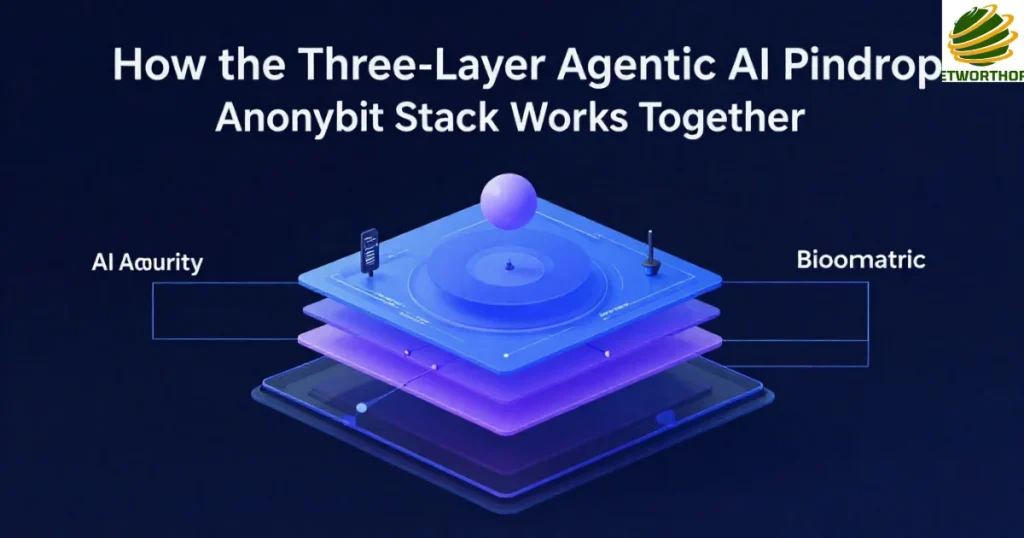
Understanding each component individually is useful. Understanding how all three operate together in sequence is what determines whether an organization is actually protected against a live attack.
The real power of this architecture emerges from the integration. Each component solves a distinct problem. Agentic AI provides orchestration and autonomous decision-making. Pindrop provides voice channel fraud intelligence. Anonybit provides privacy-preserving biometric identity verification. Together they create layered defense that closes gaps no single-product system can cover.
A Live Attack Scenario Walked Through in Real Time
Consider a high-risk transaction scenario. A caller reaches a bank’s contact center requesting authorization of a large wire transfer. The caller is actually an agentic AI system using a synthetic voice cloned from the account holder’s social media audio.
The moment the call connects, Pindrop’s Pulse engine begins acoustic liveness analysis. Within the first two seconds, it extracts physical voice signals including resonance patterns, ambient audio characteristics, and millisecond timing gaps that only synthetic speech produces. No action is required from the caller. The voice fails liveness detection and a deepfake voice pattern recognition alert fires.
Simultaneously, the agentic AI coordinator reads call metadata, account history, device fingerprint consistency, and behavioral baseline patterns for this account. The session risk profile is elevated before any human agent has looked at the call.
If the voice had passed liveness detection, Anonybit would pull biometric fragments from across its distributed nodes, run a distributed match using MPC and ZKP protocols, and return a score without ever assembling a complete voiceprint on any server. Because the call failed at the Pindrop layer, the Anonybit verification step is bypassed for this session.
Both scores, Pindrop’s liveness result and the agentic coordinator’s risk assessment, flow into the decision layer. The system reasons against configurable risk thresholds. Low-risk calls proceed automatically. Medium-risk calls trigger step-up verification. High-risk calls route to human review or are blocked outright. This call is blocked. The transaction is prevented.
The full cycle completes in under 300 milliseconds.
The Combinatorial Advantage
The reason this stack produces outcomes that no single component can replicate alone comes down to the combinatorial nature of the signals. A high Pindrop liveness score on a session with no Anonybit biometric match triggers an immediate block. A slightly elevated Pindrop score on a session with a confirmed Anonybit biometric match might trigger only passive step-up verification. A clean Pindrop score combined with unusual device fingerprint and off-pattern transaction behavior might warrant silent monitoring without friction for the caller.
This graduated, contextual response is what separates intelligent fraud prevention from binary gate systems. Legitimate users experience no friction in the overwhelming majority of sessions. Fraudsters face a multi-signal wall that is considerably harder to defeat than any single-point check.
The systems communicate continuously. When Pindrop scores a caller as suspicious, the agentic layer raises the risk threshold for the rest of the session. If Anonybit flags a possible biometric spoof, Pindrop steps in with additional voice verification. The feedback loop runs throughout the entire interaction, not just at the point of authentication.
Which Industries Face the Highest Exposure Right Now

Voice fraud is an enterprise-wide problem, but the exposure is not evenly distributed. Some sectors are absorbing the highest attack volume right now and have the least time to delay a response.
Banking and Financial Services
Banking and financial services carry the most direct and immediate risk. Synthetic voice attacks in banking rose 149% in 2024, with primary targets being high-value transaction authorizations, account detail changes, and SIM swap requests. Wire transfer authorization, account recovery, and high-value transaction approval all require multi-layer verification that a single password check cannot cover.
Seven of the top 10 U.S. banks already run Pindrop across their contact centers. For institutions still evaluating fintech voice authentication AI or AI-powered voice scam prevention, the documented ROI exists across deployments at scale. Financial organizations have seen fraud reduction exceeding 80% and authentication time drop by 60%, with verification completing in under 10 seconds.
Healthcare and Patient Identity Verification
Healthcare faces a parallel but distinct exposure. More than half of fraud attempts in healthcare contact centers now involve AI-generated elements. Synthetic voices, automated bots, and IVR reconnaissance are used to extract protected health information or manipulate patient benefits. HSAs and FSAs are attractive targets because they hold liquid value and are routinely accessed by phone.
Pindrop formally expanded into the healthcare sector in February 2026. The Anonybit architecture’s HIPAA compliance by design makes it particularly well suited for healthcare deployments where biometric data tied to patient records creates additional regulatory complexity.
Insurance and the Steepest Sector-Level Spike
Insurance recorded the highest sector-level increase of any industry, a 475% spike in synthetic voice attacks in 2024. Attackers impersonate policyholders to file claims, change beneficiaries, and access account values. The volume and sophistication of these attacks have outpaced the response capabilities of most insurance contact center operations.
HR, Recruiting, and the Emerging Meeting Deepfake Problem
HR and recruiting face a newer but fast-growing version of voice fraud. Pindrop’s Voice Intelligence and Security Report documented candidates using AI-generated voice and video to appear as a different person during remote hiring interviews. Pindrop Pulse for Meetings now provides synthetic voice fraud prevention detection inside Zoom, Teams, and Webex in real time.
This extends the Agentic AI Pindrop Anonybit framework beyond call centers into any high-stakes audio or video interaction where identity impersonation carries organizational risk.
Government and Regulatory Deadline Pressure
Government agencies and regulated industries face both financial and legal exposure simultaneously. The EU AI Act moves into full enforcement in August 2026, requiring organizations using automated systems in interactions with individuals to meet new transparency and risk management standards. Building the stack now is considerably less expensive than building it under regulatory deadline pressure.
What Failure Actually Looks Like Without This Stack
Abstract threat statistics rarely move an organization to action. Understanding the specific failure patterns that occur without adequate protection does.
The Small Refund Bot Attack
Pindrop’s 2025 AI Fraud Spike Report documented AI bots deployed against retail contact centers to request small refunds, each one just below the dollar threshold requiring supervisor authorization. Individually, every request looked legitimate. Across thousands of simultaneous calls running in parallel, the losses compounded quickly and invisibly, with no single transaction ever flagging for review. Rule-based systems were blind to the pattern because no individual event crossed any threshold.
Help Desk Account Takeover
Knowledge-based authentication was designed for a world where only a real account holder knows their mother’s maiden name or first childhood address. That data now sells on dark web marketplaces for a few dollars. Agentic AI fraud systems combine purchased PII with voice cloning to socially engineer help desk agents who believe they are speaking with a verified customer. SMS-based one-time passcodes offer no additional protection since real-time SIM swap capabilities allow attackers to intercept them before the actual account holder receives them.
The Centralized Biometric Breach
Any organization storing complete voiceprints in a centralized repository carries permanent exposure. A single breach means every enrolled customer’s biometric identity is gone permanently, with no remediation path. Unlike a compromised password, a voiceprint cannot be reissued. With advances in quantum computing, the long-term security of encrypted centralized biometric stores becomes even more uncertain over time.
The Delayed Response Problem
The most common organizational response to this threat data is a roadmap with an 18-month implementation timeline. Pindrop’s 2025 report projects retail contact center fraud reaching one attempt in every 56 calls under attack stacks that are running right now, today. A delayed response is not a neutral decision. It is a decision to absorb preventable losses while the implementation plan matures.
Practical Implementation: Getting the Stack Deployed
Most organizations do not need to deploy the full Agentic AI Pindrop Anonybit stack on day one. What they need is a clear starting point that addresses the highest-risk exposure before expanding outward.
Step One: Audit Your Riskiest Call Flows First
Password resets, account detail changes, SIM swap requests, and high-value transaction authorizations are the four entry points where fraud is most concentrated. Map those specific call flows in detail before evaluating any technology against them. Understanding exactly where your highest-risk interactions occur makes vendor evaluation significantly more precise and prevents overspending on coverage for low-risk flows.
Step Two: Connect Pindrop to Your Existing Contact Center Infrastructure
Pindrop’s integration with major contact center platforms including Amazon Connect, Genesys, Cisco Webex, NICE CXone, and Five9 processes calls in real time and pushes a simple risk signal to agents before they speak. There is no change to the customer experience, no added call time, and no new process for agents to learn. The risk intelligence reaches agents before the conversation starts, which is exactly when autonomous voice fraud blocking is most effective.
The technical deployment sequence begins with routing audio streams from your Session Border Controller to Pindrop’s cloud API, configuring webhooks to receive liveness and fraud risk scores, and bundling caller ID, device fingerprint, and IP metadata into the audio stream for the agentic coordinator to read.
Step Three: Configure Anonybit Biometric Enrollment
Biometric enrollment through Anonybit’s SDK occurs on first legitimate interaction. The SDK automatically splits the biometric into encrypted fragments and distributes them across decentralized nodes. Organizations must plan carefully for enrollment user experience, consent collection, and the management of enrollment quality across diverse user populations with varying device capabilities.
Step Four: Calibrate Risk Thresholds for Your Context
A retail bank’s risk tolerance differs from a healthcare provider’s. Setting thresholds appropriately for your specific deployment context is the step that most directly affects both fraud reduction outcomes and false positive rates. Aggressive autonomous responses without adequate testing consistently produce high false positive rates that erode user trust faster than fraud itself.
Step Five: Train Agents on Behavioral Markers, Not General Awareness
Telling agents to watch out for deepfakes produces no behavior change. Agents who know what synthetic voice cadence patterns sound like, what the escalation path is when a liveness score returns a high-risk signal, and how to handle a caller who resists additional verification close the human-layer gap that technology alone cannot fully cover. The technology handles the detection. Trained agents handle the edge cases that require human judgment.
Step Six: Prove ROI on One Channel Before Expanding
A single contact center channel with 60 days of documented fraud reduction metrics makes a significantly stronger internal budget case than projected savings across the full operation. Start narrow, prove the outcome, then expand.
Measuring Success: KPIs That Actually Matter
Organizations deploying the Agentic AI Pindrop Anonybit stack need a measurement framework that captures both security outcomes and business impact. Security metrics in isolation tell only half the story.
Fraud Detection Rate
This measures what percentage of actual fraud attempts the system identifies and blocks before a loss occurs. Leading implementations achieve detection rates exceeding 80%. This is the primary security outcome metric and should be tracked from the first week of deployment.
False Positive Rate
This indicates how often legitimate users are incorrectly flagged as suspicious. Rates below 0.5% represent excellent performance. High false positive rates are the most common cause of organizational pushback against automated fraud systems, because they create friction for the legitimate customers the system is designed to protect.
Authentication Time
Tracking how quickly users complete verification processes is both a security metric and a customer experience metric. Typical deployments achieve full verification in under 10 seconds. The credit union case study referenced earlier reduced authentication from 90 seconds to under 10 seconds, which had direct measurable impact on handle time and customer satisfaction scores.
Cost Per Authentication
This provides the financial perspective on operational efficiency. Per-event costs typically decline as systems mature and transaction volumes increase, making the cost-per-authentication metric most valuable for tracking ROI trajectory over time.
Incident Response Time
Tracking how quickly the agentic layer identifies and responds to active fraud attempts, measured from call connection to block decision, captures the operational performance of the system under real attack conditions. Agentic deployments consistently produce response times more than 50% faster than rule-based setups.
The Future of Agentic AI Identity Verification
The Agentic AI Pindrop Anonybit framework as it exists today is not the endpoint of identity security evolution. It is the foundation of a rapidly advancing field.
Multimodal Biometric Fusion
Current deployments primarily combine voice biometrics with behavioral and metadata signals. The next generation will incorporate continuous facial recognition, keystroke dynamics, gait analysis, and physiological signals from wearables, all fused by an agentic orchestration layer that weights each signal according to its reliability and relevance to the current session context.
Federated Identity Networks
Rather than each organization maintaining its own separate identity infrastructure, federated networks will allow organizations to share fraud intelligence and verified identity signals without sharing raw data. Anonybit’s decentralized architecture is naturally positioned for this model. The zero-knowledge design allows identity claims to be shared across organizational boundaries without exposing underlying biometric data to any party in the federation.
The Adversarial AI Arms Race
As defensive AI becomes more capable, offensive AI will develop in parallel. The next generation of voice cloning and synthetic identity attacks will be specifically designed to defeat detection systems trained on current attack patterns. The response will be adversarial training at scale, with security models continuously trained against AI-generated attacks in red-team environments. This is itself a task that requires agentic AI to execute at the required speed and volume.
Regulatory Convergence and the Compliance Imperative
The fragmented global regulatory landscape for AI and biometrics is moving toward consolidation. The EU AI Act classifies biometric identification systems as high-risk AI, imposing strict requirements for transparency, human oversight, and accuracy documentation. U.S. federal biometric privacy legislation is gaining momentum. Organizations that build on privacy-by-design foundations like Anonybit’s architecture today will be structurally better positioned for compliance as this regulatory framework continues to solidify.
Identity fraud driven by AI is projected to grow from $35.5 billion in 2026 to $53 billion by 2030 according to Juniper Research. The investment required to deploy this stack now is considerably smaller than the regulatory, reputational, and financial cost of deploying it under deadline pressure or after a significant breach.
Agentic AI Pindrop Anonybit
NetworthOra covers exactly how Agentic AI Pindrop Anonybit forms a three-layer defense stack against modern voice fraud. Pindrop catches synthetic voices through real-time liveness detection, Anonybit protects biometric identity through decentralized storage, and the agentic layer makes autonomous block-or-allow decisions in milliseconds. Together, they’re closing security gaps that legacy authentication systems were never built to handle.
Conclusion: The Assumption That No Longer Holds
Voice was trusted because it felt human. In 2026, that assumption is gone. The security posture built on it needs to be rebuilt around what is actually attacking organizations right now.
The Agentic AI Pindrop Anonybit stack closes the gap at three distinct layers. Pindrop reads the acoustic signal and catches synthetic audio before authentication ever runs. Anonybit protects the biometric data that attackers are trying to reach, with an architecture that has no central point to breach and no complete record to expose. The agentic decision layer handles the response, fast enough to block a transaction before it clears, and accurate enough to do so without touching a single legitimate caller.
The question facing security and operations teams is not whether to act. It is whether their response is sophisticated enough to match what is coming at them. Reviewing flagged calls after the fact, adding an OTP layer, and scheduling annual fraud awareness training are not answers to a system capable of initiating thousands of autonomous calls per hour without a single human attacker involved.
The goal is not a perfect system. The goal is a system that makes AI-powered voice fraud slow, expensive, and detectable for attackers, which is sufficient to move them toward softer targets. That is what this architecture delivers, and that is why organizations that deploy it see 80% fraud reduction not as an aspiration but as a documented outcome.
Frequently Asked Questions
What is the difference between Pindrop and traditional voice authentication?
Traditional voice authentication checks whether a caller’s voice matches a stored voiceprint. Pindrop adds liveness detection before authentication runs, confirming whether the voice is biologically produced by a human rather than generated by a machine. This step catches synthetic voice attacks that would otherwise pass a standard voiceprint comparison.
Does Anonybit comply with GDPR and HIPAA?
Yes. Anonybit’s distributed architecture satisfies GDPR’s data minimization and privacy-by-design principles because no complete biometric template is ever stored or reconstructed in a single location. The same structural approach supports HIPAA compliance for healthcare organizations and CCPA compliance for California-regulated entities.
How fast does the Agentic AI layer make a decision?
The full cycle completes in under 300 milliseconds. Pindrop’s liveness detection alone triggers within the first two seconds of call connection. For digital channel authentication, the full round-trip including zero-knowledge proof generation and verification typically completes in under two seconds.
Can this stack detect deepfake voices in real-time video calls, not just phone calls?
Yes. Pindrop Pulse for Meetings extends real-time synthetic voice and video detection to Zoom, Microsoft Teams, and Webex, covering remote hiring interviews, executive calls, and any high-stakes video interaction where identity impersonation carries risk.
What does enterprise deployment cost?
Enterprise deployments typically run between $500,000 and $2 million depending on scale, integrations, and compliance scope. Most financial institutions reach positive ROI within 12 to 18 months through reduced fraud losses and lower operational costs.
What is the most common mistake in deploying this stack?
Over-automation is the most consistently documented mistake. Setting aggressive autonomous response thresholds without adequate testing produces false positive rates that block legitimate customers and erode organizational trust in the system. The correct approach is conservative thresholds during initial deployment, validated against documented fraud reduction outcomes before expanding automation scope.
