What Is Smokey Robinson Net Worth?
Smokey Robinson net worth is estimated at around $150 million in 2026, a fortune built over more than six decades as a Motown hitmaker, solo star, record producer, and music executive. From growing up poor in Detroit to becoming one of the most influential figures in American music history, Robinson’s financial journey is as remarkable as his artistic one. His wealth comes from multiple streams including songwriting royalties, album sales, live performances, real estate investments, and his long tenure as Motown’s vice president. Even at 85 years old, he continues to perform, record, and earn, making his story one of the most enduring in the music industry.
Also Read: Brittany Renner Net Worth 2026: Full Details
Who Is Smokey Robinson?
William “Smokey” Robinson Jr. was born on February 19, 1940, in Detroit, Michigan. He grew up in a low-income household in the North End area of Detroit, raised in a neighborhood that was rich in culture despite its economic hardships. His uncle Claude gave him the nickname “Smokey Joe” during childhood, a name that came from their shared love of cowboy movies. Over time, he dropped the “Joe” and simply became Smokey, a name that would eventually be recognized all over the world.
From an early age, Robinson showed a deep passion for music. He listened to artists like Nolan Strong and the Diablos and Billy Ward and his Dominoes on the radio, absorbing different styles and sounds that would later shape his own musical identity. He attended Northern High School in Detroit, where he was above average academically but far more passionate about music than anything else. It was there that he formed a doo-wop group called the Five Chimes, which would eventually evolve into one of the most successful groups in Motown history.
Robinson’s childhood was not without hardship. His mother passed away when he was just ten years old, and he moved in with his older sister Geraldine. These early life experiences gave him a depth of emotion that would later pour into his songwriting, creating music that resonated with millions of people across generations. His parents were William Robinson Sr. and Flossie Robinson, and he had two maternal half-sisters, Rose Ella Jones and Geraldine Burston.
Also Read: Nate Burleson Net Worth 2024: $18M Fortune
Early Career and The Miracles
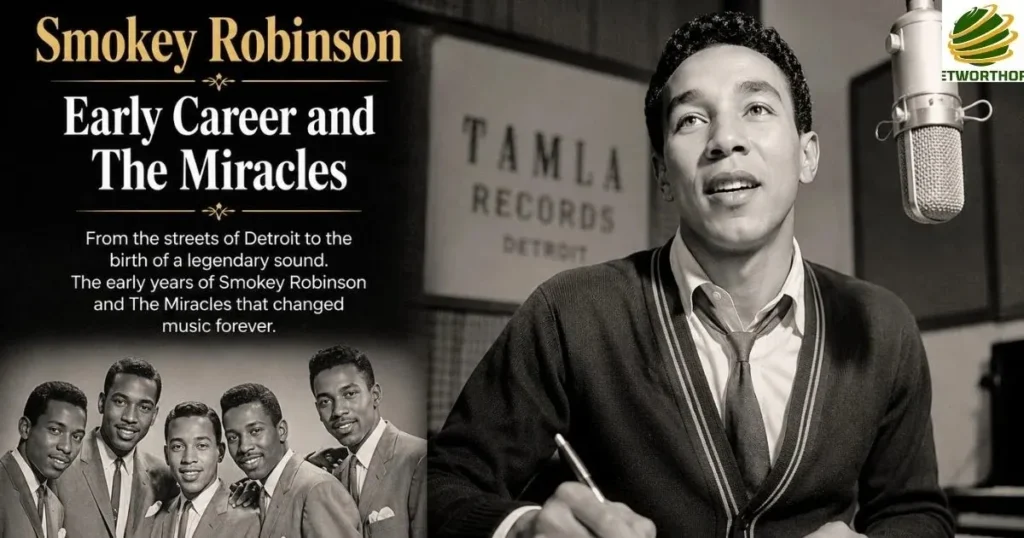
Robinson’s professional music career truly began in the late 1950s when his group, by then renamed the Matadors, crossed paths with a young songwriter named Berry Gordy. In August 1957, they met after a failed audition for Brunswick Records. Robinson had brought along a notebook filled with over 100 songs he had written during high school, which immediately impressed Gordy. That meeting changed the course of both their lives.
With Gordy’s help, the group released their first single, “Got a Job,” an answer song to the Silhouettes’ hit “Get a Job.” The group soon changed their name to the Miracles, and after Gordy formed Tamla Records, which later became Motown Records, they became one of the very first acts signed to the label. Robinson was simultaneously attending college, studying electrical engineering, but dropped out after just two months once the music started gaining traction.
The real breakthrough came in late 1960 when the Miracles released “Shop Around,” which became Motown’s first million-selling hit record. This single sale of over a million copies marked the beginning of a remarkable decade for both the Miracles and Motown. Between 1960 and 1970, Robinson produced 26 top forty hits with the group as lead singer, chief songwriter, and producer. Songs like “You’ve Really Got a Hold on Me,” “Mickey’s Monkey,” “I Second That Emotion,” “Baby Baby Don’t Cry,” and “The Tears of a Clown” became staples of American R&B and soul music.
In 1965, to reflect Robinson’s central role in the group, the Miracles officially changed their name to Smokey Robinson and the Miracles. This was not just a symbolic gesture but an acknowledgment of his creative dominance within the group. His high tenor voice, combined with his ability to write deeply emotional and poetic lyrics, set him apart from his contemporaries.
Also Read: Violet Myers Net Worth 2026: Revealed
Smokey Robinson as a Songwriter and Producer for Motown
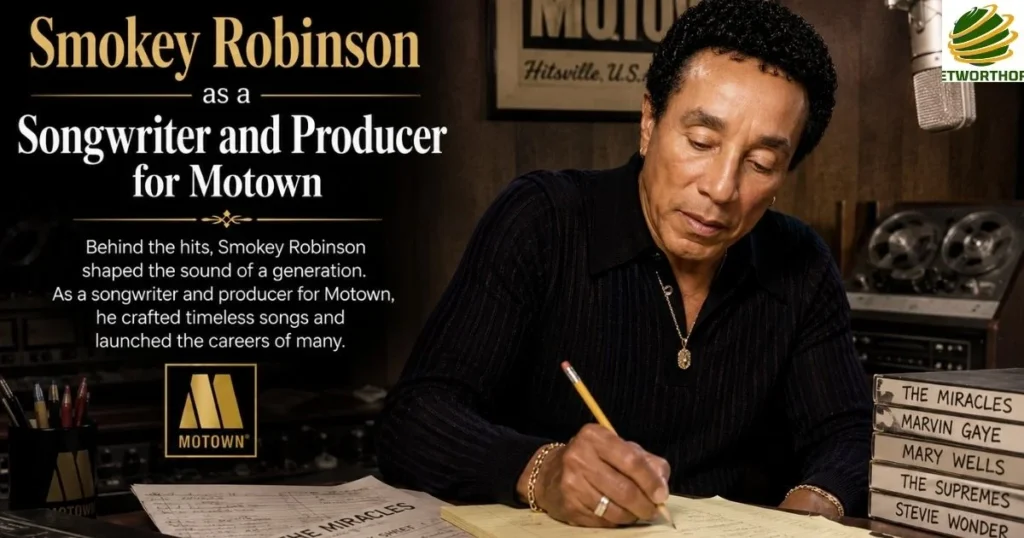
Beyond his work with the Miracles, Robinson was one of the most prolific songwriters and producers at Motown Records throughout the 1960s. His pen was responsible for hit songs recorded by some of the biggest names in music. He wrote “My Girl” and “The Way You Do the Things You Do” for the Temptations, “My Guy” and “Two Lovers” for Mary Wells, “I’ll Be Doggone” and “Ain’t That Peculiar” for Marvin Gaye, and “Don’t Mess With Bill” for the Marvelettes, among many others.
Bob Dylan once famously called Robinson “America’s greatest living poet,” a tribute that speaks to the literary quality of his songwriting. His ability to craft deeply emotional, metaphor-rich lyrics set him apart not just as a musician but as a genuine artist. Over his career, Robinson has written or co-written more than 4,000 songs, a staggering number that ensures a continuous stream of royalty income from streaming platforms, radio airplay, film placements, and cover versions.
His work as a producer was equally impressive. He helped shape the careers of multiple Motown artists, contributing to the overall sound that made Motown Records the most commercially successful Black-owned business in America during the 1960s. Robinson’s role behind the scenes was just as important as his role in the spotlight, and it is a major reason why his legacy and financial worth have remained strong for so many decades.
Also Read: Lana Rhoades Net Worth: Multi-Millionaire Life
Robinson’s Role as Motown Vice President
By the mid-1960s, Robinson had taken on the role of vice president at Motown Records, stepping into the position after Esther Gordy Edwards had left. This executive role added a significant new income stream to his growing wealth. As vice president, he was not just a creative force but also a business decision-maker who helped guide the label during some of its most critical years.
His dual role as both an artist and an executive was challenging, and it eventually had an impact on his solo output. Albums released during this period were often under-promoted because Robinson’s attention was divided between his creative work and his administrative responsibilities. However, the executive experience gave him a deeper understanding of the music business, which would serve him well in the decades that followed.
When Motown was acquired by MCA in 1988, Robinson relinquished his position as vice president and chose to focus entirely on his music. This transition marked the beginning of a new chapter in his career, one that allowed him to concentrate on performing and recording without the burden of corporate responsibilities.
Also Read: Carla Diab Family Net Worth 2026 and Career
Solo Career Success and Major Hits
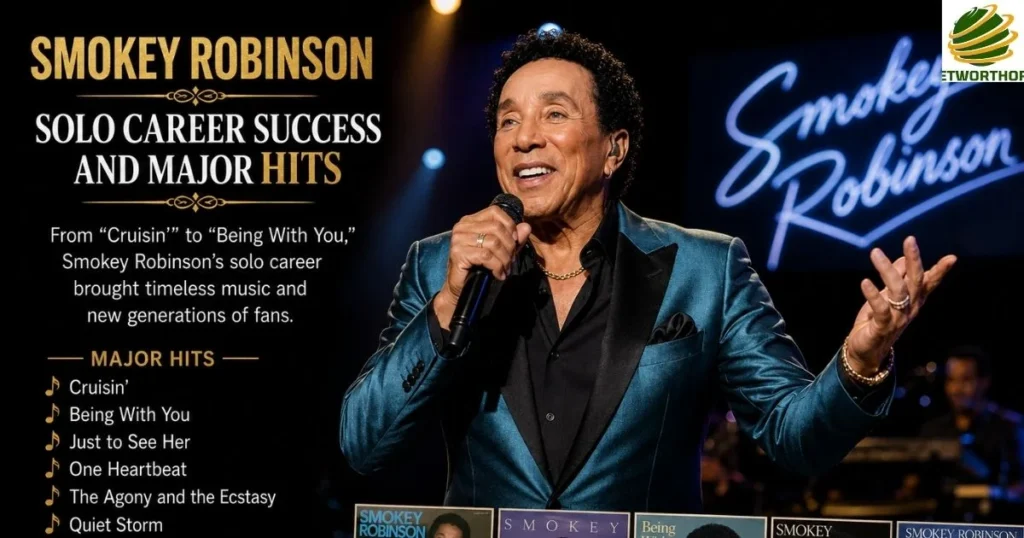
Robinson began his solo career in 1973 after leaving the Miracles, releasing his debut solo album simply titled “Smokey.” While the early solo albums did not immediately make a major commercial impact, he was competing against established solo artists like Marvin Gaye and Stevie Wonder, two artists who had also grown out of the Motown ecosystem and were producing critically acclaimed work during the same period.
His breakthrough as a solo artist came in 1975 with the album “A Quiet Storm,” which contained hits like “Baby That’s Backatcha” and the title track “Quiet Storm.” The radio format quiet storm, which became a staple of adult contemporary R&B stations across America, was actually named after this album, a testament to its cultural impact.
In 1979, Robinson scored his first major solo hit on the pop charts with “Cruisin’,” a sensual ballad that reached the top ten and became one of his most recognizable songs. This was followed in 1981 by “Being with You,” which topped the charts in the United Kingdom and reached number two on the Billboard Hot 100 in the United States, becoming his most commercially successful single at that time.
The album “One Heartbeat” in 1987 represented another high point in his solo career. It contained top-ten singles including “Just to See Her” and the title track “One Heartbeat.” The single “Just to See Her” won Robinson his first Grammy Award in 1988 for Best Male R&B Vocal Performance. The album sold over 900,000 copies in the United States alone, demonstrating that Robinson still had enormous commercial appeal more than two decades into his career.
Also Read: Damon Darling Net Worth 2026: Wealth & Career
Smokey Robinson Net Worth: Breaking Down the $150 Million Fortune
Robinson’s estimated net worth of $150 million in 2026 comes from a combination of sources that have built up steadily over six decades. Understanding where this money comes from gives a clearer picture of how an artist can turn creative talent into lasting financial security.
Also Read: NBA YB Net Worth 2026: Rapper’s Real Earnings
Songwriting and Publishing Royalties
The single largest contributor to Robinson’s net worth is almost certainly his songwriting and publishing catalog. With over 4,000 songs written or co-written throughout his career, Robinson earns royalties every time one of those songs is streamed, played on the radio, licensed for a film or television show, or recorded as a cover version. Classic tracks like “The Tracks of My Tears,” “My Girl,” “Shop Around,” and “Cruisin'” continue to generate significant income decades after they were first recorded.
Publishing royalties are particularly valuable because they do not diminish over time in the way that a performer’s live appeal might. Every new generation that discovers Motown music adds to the royalty stream. Streaming platforms in particular have opened up new revenue opportunities for catalog owners like Robinson, as songs that were once limited to radio and physical sales now generate income every time someone presses play anywhere in the world.
Also Read: Candace Owens Husband Net Worth: Revealed
Record Sales Income
Throughout his career with the Miracles and as a solo artist, Robinson accumulated substantial income from record sales. The album “Being with You” in 1981 sold approximately 500,000 copies, generating an estimated $650,000 in record sales revenue. “One Heartbeat” in 1987 also sold approximately 500,000 copies, adding another $650,000 in direct record sales. Earlier, the album “Going to a Go-Go” with Smokey Robinson and the Miracles similarly sold around 500,000 copies.
While these individual figures may seem modest compared to the total net worth, they represent just a fraction of the cumulative record sales income Robinson has earned across dozens of albums and singles over more than half a century of recording. When compounded with royalties from continuing catalog sales and digital streams, the total lifetime income from record sales is substantially higher.
Live Performances and Touring
Robinson has maintained an active touring and performance schedule throughout much of his career. Artists of his stature and legacy command substantial appearance fees, particularly for major festivals, tribute events, and nostalgia tours that draw audiences who grew up with Motown music. Even well into his eighties, Robinson continues to perform live, which means touring income remains an active part of his financial picture.
Live performance fees for legendary artists at his level can range from hundreds of thousands of dollars per appearance for major events. Over the course of a career spanning more than fifty years, the cumulative income from touring and live performances represents a significant portion of his overall wealth.
Motown Executive Salary and Influence
His years as vice president of Motown Records brought executive-level compensation in addition to his artist income. While specific salary figures have never been publicly disclosed, executive roles at major record labels during Motown’s peak years in the 1960s and 1970s came with significant compensation packages. Beyond the direct salary, his executive position gave him access to business relationships and opportunities that continued to pay dividends long after he stepped down from the role.
Real Estate Investments
Robinson has made several significant real estate investments in California that have contributed to his overall wealth. In 2002, he sold his home in Encino, Los Angeles, for $2.3 million. The property, built in 1912, featured 10,600 square feet of living space, an 800-square-foot private deck, and 1.5 acres of land with English-style gardens. That same property was later sold again in 2017 for $8.3 million, more than tripling in value in fifteen years.
He also listed a large mansion in the Chatsworth neighborhood of Los Angeles, an area known for housing many celebrities. This 9,075-square-foot property, which included a separate 2,000-square-foot guest house, was originally listed for $10.5 million in 2005 before being re-listed at $10 million in 2007 and eventually offered at $7.99 million in 2014. While the final selling price was lower than the original asking price, the property still represented a significant asset.
Robinson and his current wife Frances Gladney also own property in Pittsburgh, where they operate a small winery, adding another dimension to his investment portfolio.
Personal Life and Relationships
Robinson’s personal life has been as complex as it has been public. His first marriage was to Claudette Rogers, who was also a member of the Miracles. The two had known each other since their early days in the group, and they married in 1959. Together, they had two children: a son named Berry Robinson, born in 1968 and named after Motown founder Berry Gordy, and a daughter named Tamla Robinson, born in 1971 and named after the original Tamla label that Gordy had set up.
However, Robinson’s marriage to Claudette was troubled by infidelity. He has spoken openly about having affairs with multiple women during the marriage, including a reported relationship with Diana Ross, who was a close friend of Claudette. Robinson has also acknowledged that he and Diana Ross had been neighbors growing up, with Robinson saying he had known her since she was about five years old.
In 1984, Robinson fathered a son named Trey Robinson with another woman during his marriage to Claudette. After admitting to fathering a child outside the marriage, Robinson filed for legal separation and eventually for divorce, which was finalized in 1986. The divorce was financially costly, with reports indicating that Robinson agreed to a $20 million cash payment to Claudette, along with two properties and $100,000 in monthly alimony payments for twelve years.
In 2002, Robinson married Frances Gladney, and the two have remained together since. Robinson has spoken positively about his current marriage and his later-life stability, even as new controversies have emerged in recent years.
Robinson has not eaten red meat since 1972 and practices Transcendental Meditation, habits that he credits with helping him maintain his energy and vitality well into his eighties. He is known for his golden green eyes, which he believes were passed down from his French great-grandmother.
Substance Abuse and Personal Struggles
Robinson has been open about his battles with substance abuse, a struggle that emerged during his adult years despite having been teetotal, vegetarian, and completely drug-free in his younger days. He began using marijuana and later cocaine, a period in his life that he has described as deeply damaging both personally and professionally.
His recovery from substance abuse is one of the more inspiring chapters of his personal story. Robinson turned away from drugs and rebuilt both his personal life and his professional reputation, eventually becoming one of the most respected elder statesmen of American music. His willingness to speak openly about his addiction and recovery has made him a relatable figure to many fans who have faced similar struggles.
Awards, Honors, and Industry Recognition
Robinson’s list of awards and honors is extensive, reflecting the enormous respect he commands within the music industry and beyond. He was inducted into the Rock and Roll Hall of Fame as a solo artist in 1987, and then again as part of the Miracles in 2012. He was also inducted into the Songwriters Hall of Fame in 1990, recognizing his extraordinary contribution as a writer of popular music.
In 2016, Robinson received the Library of Congress Gershwin Prize for Popular Song, one of the most prestigious honors available to American musicians. This prize recognized his lifetime contributions to popular music and placed him among an elite group of artists who have shaped American culture through their music.
He has two stars on the Hollywood Walk of Fame, one awarded in 1983 as a solo artist and another in 2009 as part of the Miracles. In 2022, he was inducted into the Black Music and Entertainment Walk of Fame. He received the National Medal of Arts in 1993, the Heritage Award at the Soul Train Music Awards, and a BET Lifetime Achievement Award in 2015. In 2006, he was one of five Kennedy Center honorees, alongside Dolly Parton, Zubin Mehta, Steven Spielberg, and Andrew Lloyd Webber.
Rolling Stone ranked Robinson at number 23 on their list of the 200 Greatest Singers of All Time in 2023, a recognition that placed him firmly among the greatest vocal artists in the history of recorded music.
Controversies and Legal Challenges in 2025
The most significant recent development affecting both Robinson’s reputation and potentially his financial standing is a series of legal allegations that emerged in 2025. In May of that year, four former housekeepers filed a civil lawsuit against Robinson and his wife Frances, accusing him of sexual battery, assault, and false imprisonment. The women, identified as Jane Does 1 through 4, alleged that the incidents occurred over a period spanning from 2012 to 2024 at Robinson’s properties in California and Nevada.
The plaintiffs were seeking no less than $50 million in general damages. They stated that they had not come forward earlier due to fears about losing their livelihood, concerns about familial reprisal, embarrassment, and in some cases, worries about how speaking out might affect their immigration status. The lawsuit also named Frances Robinson, accusing her of creating a hostile work environment and using ethnically pejorative language toward the employees.
Robinson denied the allegations. His attorney Christopher Frost stated that the evidence would show the lawsuit was simply an attempt to extract money from an 85-year-old American icon. On May 28, 2025, Robinson filed a $500 million counter-complaint against his former employees, accusing them of slander, intentional infliction of emotional distress, and financial elder abuse. The counter-complaint stated that the women had made pre-litigation demands for $100 million or more, which were not met before they pursued legal action.
In May 2025, it was also reported that Robinson was under criminal investigation by the Los Angeles County Sheriff’s Department. By May 30, 2025, it was revealed that Robinson had previously been the subject of a criminal investigation related to allegations from an unrelated fifth woman, but that case had been dismissed for insufficient evidence. In November 2025, two additional former employees joined the original lawsuit, bringing the total number of plaintiffs to six.
The outcome of this legal battle remains uncertain, and it has the potential to significantly affect both Robinson’s public image and his financial standing, depending on how the case ultimately resolves.
Smokey Robinson in 2026: Still Active at 85
Despite the legal challenges and controversies of recent years, Smokey Robinson remains an active presence in the music world. He continues to tour and perform, drawing audiences that span multiple generations. His songs continue to appear in films, television shows, and commercials, generating ongoing royalty income that keeps his financial picture strong.
In 2023, he released a new album called “Gasms,” his first collection of entirely new material in nearly a decade, demonstrating that his creative energy has not diminished with age. In 2025, he released another album called “What the World Needs Now,” continuing his pattern of staying artistically engaged even as he navigates personal and legal challenges.
Robinson is also the current owner and host of the SiriusXM channel Soul Town, a station dedicated to R&B and soul hits from the 1950s to the early 1980s. Known as Smokey’s Soul Town, the channel gives him a contemporary platform to connect with audiences and share his deep knowledge of Motown history and soul music culture.
His continued activity in the music industry ensures that the cultural value of his brand remains high, which in turn supports the licensing value of his catalog and the fees he can command for personal appearances. Few artists at the age of 85 are still this commercially and creatively active, which makes Robinson’s story genuinely exceptional.
How Smokey Robinson’s Net Worth Compares to Other Motown Legends
When placed alongside other artists from the Motown era, Robinson’s estimated net worth of $150 million is impressive but not entirely surprising given the depth and breadth of his catalog. Berry Gordy, the founder of Motown Records, built a fortune estimated in the hundreds of millions through his ownership of the label itself before selling it. Diana Ross, who became one of Motown’s biggest international stars, has an estimated net worth significantly lower than Robinson’s, in part because Robinson’s income from songwriting royalties has continued to compound over time in a way that performance-based income alone cannot replicate.
Stevie Wonder and Marvin Gaye were both contemporaries of Robinson at Motown. Gaye passed away in 1984, and his estate continues to earn royalties. Wonder, still active, has accumulated a fortune through both his own songwriting catalog and decades of touring. The comparison highlights an important point: at Motown, the artists who held onto their songwriting rights and built publishing catalogs ended up with the most enduring wealth.
Robinson’s decision to remain prolific as a songwriter throughout his career, rather than focusing solely on performing, is the primary reason his net worth has remained as strong as it has for as long as it has. Songwriting catalogs are among the most valuable assets in the modern music industry, as demonstrated by the high prices that major catalogs have fetched in recent years.
The Legacy of Smokey Robinson
Smokey Robinson’s legacy extends far beyond the numbers in his bank account. He helped create a sound that defined an era, gave voice to the emotional lives of millions of people, and shaped the direction of American popular music for decades. His influence can be heard in the work of countless artists across R&B, soul, pop, and even hip-hop, where samples of his recordings continue to appear regularly.
His role as both an artist and an executive at Motown made him one of the most complete figures in the history of the music business. He was not just a performer who benefited from the Motown machine; he was one of the architects of that machine, helping to build the infrastructure and the sound that made Motown Records one of the most important cultural institutions in twentieth-century America.
Bob Dylan’s description of Robinson as “America’s greatest living poet” captures something essential about what makes his contribution so significant. It was not just that Robinson wrote catchy songs. It was that he wrote songs that were genuinely literary in their use of language, imagery, and emotion. Songs like “The Tracks of My Tears” and “Ooo Baby Baby” are as carefully crafted as any poem, and they have proven just as lasting.
As Robinson moves through his mid-eighties, his story remains a testament to the power of creative ownership, artistic longevity, and the enduring value of great songwriting. Whatever happens with the legal proceedings currently surrounding him, his musical legacy is already secured. The checks will keep coming in, the songs will keep being discovered by new listeners, and the name Smokey Robinson will remain synonymous with the very best that American soul and R&B music has ever produced.
How Rich Is Smokey Robinson
Smokey Robinson is genuinely one of the wealthiest figures to come out of the Motown era. His $150 million fortune places him among the richest R&B and soul artists of his generation, a rank earned not through inheritance or business deals alone but through owning a songwriting catalog of over 4,000 songs that continues generating royalty income every single day. Unlike many artists whose wealth fades after their peak years, Robinson’s financial standing has remained strong because his music never stopped being discovered, licensed, and streamed by new audiences around the world.
Smokey Robinson Age 2026
Smokey Robinson was born on February 19, 1940, which makes him 86 years old as of 2026. What makes his age particularly remarkable is that he remains professionally active, continuing to perform live, release music, and host his own SiriusXM channel called Smokey’s Soul Town. Very few artists in music history have maintained this level of visibility and creative output at such an advanced age, making Robinson a truly exceptional figure in the entertainment world.
Smokey Robinson Net Worth Forbes
Forbes has not published a dedicated profile confirming Smokey Robinson’s exact net worth, but the $150 million figure that circulates widely is consistently cited by major celebrity wealth tracking platforms including Celebrity Net Worth. This estimate is based on his cumulative earnings from songwriting royalties, record sales, live performances, real estate transactions, and his long executive career at Motown Records. Industry analysts generally consider this figure a reliable and well-supported approximation of his total wealth as of 2026.
Nate Robinson Net Worth 2026
Nate Robinson is a former NBA player, known for his explosive athleticism and three NBA Slam Dunk Contest titles during his professional basketball career. His net worth as of 2026 is estimated at around $14 million, accumulated through his NBA salary across multiple teams including the New York Knicks, Boston Celtics, Oklahoma City Thunder, and Chicago Bulls. Since retiring from professional basketball, Robinson has stayed connected to sports through various media appearances and community-based activities.
Final Thoughts on Smokey Robinson Net Worth
Smokey Robinson net worth of $150 million in 2026 is the result of more than six decades of relentless creativity, smart business decisions, and an extraordinary talent for writing music that connects deeply with human emotion. From the streets of Detroit to the heights of the Motown empire, Robinson built his fortune not through luck or a single moment of fame but through consistent hard work, artistic integrity, and a deep understanding of both music and business.
His story is also a reminder that wealth built on creative ownership is among the most durable kind. While other artists from his era have seen their fortunes fluctuate with the tides of fashion and public taste, Robinson’s songwriting catalog has continued to generate income regardless of what is happening in the broader music market. In an era when music catalog acquisitions have become a major investment category, the value of what Robinson owns is arguably greater today than it has ever been.
At 85 years old, still performing, still recording, still earning, and still influencing, Smokey Robinson is living proof that great music truly lasts forever.
Frequently Asked Questions
How much is Smokey Robinson worth right now?
As of 2026, Smokey Robinson net worth is estimated at $150 million, earned through six decades of songwriting royalties, record production, touring, and his executive role at Motown Records.
How many marriages has Smokey Robinson had?
Smokey Robinson has been married twice — first to fellow Miracles member Claudette Rogers from 1959 to 1986, and then to Frances Gladney, whom he married in 2002.
Does Smokey Robinson identify as black?
Yes, Robinson proudly identifies as a Black American and has publicly spoken about embracing that identity, emphasizing that Black contributions to culture and history deserve equal recognition alongside those of their white peers.
Did Diana Ross ever date Smokey Robinson?
Yes, Robinson has openly admitted to having a romantic affair with Diana Ross that lasted approximately one year while he was still married to his first wife Claudette Rogers, describing it as something that simply happened naturally between them.
How old is Smokey Robinson’s wife Frances?
Frances Gladney, Smokey Robinson’s wife, was born on February 19, 1952, in California, making her 74 years old as of 2026.
