Cillian Murphy biography is one of the most inspiring stories in modern cinema — a tale of artistic integrity, quiet determination, and extraordinary talent that took a young man from the streets of Cork, Ireland, to the grandest stages in Hollywood. Born on May 25, 1976, in Douglas, Cork, Cillian Murphy grew up in a modest, education-focused household that had no direct connection to the entertainment industry. Yet, through a series of unexpected turns — a failed law degree, a rejected music contract, and a fateful encounter with experimental theater — Murphy discovered his true calling and spent the next three decades building one of the most remarkable careers in contemporary acting.
What makes Cillian Murphy’s journey particularly compelling is not just the roles he played or the awards he collected, but the manner in which he built his success. At a time when Hollywood demanded conformity, social media presence, and constant visibility, Murphy chose the opposite path. He avoided celebrity culture, refused to engage with social media, moved his family back to Dublin rather than settling in Los Angeles, and consistently prioritized artistic quality over commercial calculation. This approach, which many industry observers initially questioned, ultimately proved to be the foundation of a career that reached its pinnacle in 2024 when Murphy stood on the Oscars stage holding the Academy Award for Best Actor for his breathtaking portrayal of J. Robert Oppenheimer in Christopher Nolan’s biographical epic.
From his early theater work in Cork to his breakthrough in Danny Boyle’s 28 Days Later, from his iconic portrayal of Tommy Shelby in Peaky Blinders to his Oscar-winning performance in Oppenheimer, Cillian Murphy has demonstrated again and again that genuine talent, disciplined preparation, and unwavering integrity can achieve what no amount of strategic career management or celebrity posturing ever could. This is the complete, detailed story of Cillian Murphy — where he came from, how he built his career, who he is as a person, and why, in 2026, he remains one of the most relevant and respected figures in global cinema.
Also Read: Christa Podsedly: Who Is She in 2026?
Early Life and Family Background of Cillian Murphy
Cillian Murphy was born on May 25, 1976, in Douglas, a quiet suburban area located on the southern edge of Cork city in the Republic of Ireland. Cork, Ireland’s second-largest city, has a distinct cultural identity that differs markedly from the cosmopolitan energy of Dublin. It is a city proud of its regional character, its arts scene, its people, and its particular way of seeing the world. Growing up in this environment gave Cillian Murphy a grounding in Irish life that would profoundly shape his identity as both a person and an artist.
His father, Brendan Murphy, worked for the Irish Department of Education, initially as a school inspector and later as a civil servant. His mother, whose name has been kept largely out of public records at the family’s request, was a French teacher. Both parents were deeply committed to education, and the household in which Cillian grew up placed enormous value on academic achievement, intellectual curiosity, and cultural enrichment. This environment, while not glamorous, gave Murphy a strong foundation in critical thinking and a genuine appreciation for the arts that would serve him throughout his career.
Murphy grew up alongside three younger siblings — his brother Páidi and his sisters Sile and Orla. The family lived in Ballintemple, a residential neighborhood in Cork, and by all accounts led a comfortable, conventionally middle-class Irish life. Murphy has spoken warmly about his upbringing in various interviews, describing Cork as a place that instilled in him a certain skepticism about pretension and a deep appreciation for authenticity — values that would become central to his approach to both acting and life more broadly.
Also Read: Cillian Murphy Height in Feet: Measurement
Cillian Murphy Biography, Childhood and School Years
Murphy attended Presentation Brothers College, a fee-paying Catholic secondary school in Cork. The school had a strong academic reputation and a particular emphasis on sports, particularly rugby, which was central to the school’s culture. Murphy, by his own admission, was never particularly interested in sports. He excelled academically but found that the school’s emphasis on athletics left little room for the artistic pursuits that fascinated him most. This tension between conventional expectations and personal artistic inclinations would recur throughout his early life.
It was at Presentation Brothers College that Murphy first encountered formal performance. He participated in a drama module presented by Pat Kiernan, the director of Cork’s experimental Corcadorca Theatre Company. Murphy has described this experience as a revelation — a feeling of being fully alive and fully present that he immediately recognized as something he wanted to chase. Novelist William Wall, who was his English teacher at the time, recognized Murphy’s potential and encouraged him to pursue acting. Murphy, however, was not yet ready to commit to that path. Instead, he was convinced he was going to be a rock star.
Also Read: London Bierk: Rock Legend’s Hidden Son
Music Career and the Road Not Taken
In his late teens, Murphy threw himself into music with genuine passion and considerable ambition. Alongside his brother Páidi, he formed a series of bands, the most successful of which was called The Sons of Mr. Green Genes — a name borrowed from a Frank Zappa composition, which immediately tells you something about the kind of music they were making. This was not simple pop music but something more experimental, more adventurous, and more intellectually ambitious.
The band developed a following in Cork and beyond, and their efforts were eventually noticed by Acid Jazz Records, a respected independent label. The label offered the band a five-album deal — a significant opportunity for young musicians from Cork with no industry connections. Murphy and his brother turned the offer down. The reason was simple but revealing: accepting the deal would have meant signing away the rights to Murphy’s compositions for a relatively small sum of money. Even at that young age, Murphy understood the value of creative ownership and was unwilling to surrender it for the sake of immediate commercial opportunity. This decision, which might have seemed foolish to some at the time, reflects a quality of character that would define his entire career.
The collapse of the music dream coincided with another significant turning point. Murphy had enrolled at University College Cork to study law — a sensible, respectable career path that would have satisfied parental expectations. But Murphy failed his first-year exams, not because he lacked intelligence, but because, as he has said, he had no ambitions to do it. He knew within days of starting at UCC that law was not for him. It was around this time that he attended a production of A Clockwork Orange staged by Corcadorca Theatre Company, directed by Pat Kiernan. Something clicked. Murphy redirected his energy toward acting, dropped out of law school, and never looked back.
Also Read: Aran Murphy: Cillian Murphy’s Son, Biography
Cillian Murphy’s Theater Career and Early Acting Roles
The decision to pursue acting professionally led Murphy back to Pat Kiernan and the Corcadorca Theatre Company. He pressured Kiernan for an audition, displaying a determination that would characterize his professional approach throughout his career. In September 1996, Murphy made his professional acting debut on the stage, playing the part of a volatile Cork teenager named Pig in Enda Walsh’s two-character play Disco Pigs. This single decision — to fight for and win that role — changed the entire trajectory of his life.
Enda Walsh, who would become one of Murphy’s most important creative collaborators, recalled his first impression of Murphy with characteristic directness. There was something about him, Walsh said — an enigmatic quality, a genuine presence when he walked into a room that had nothing to do with his now-famous blue eyes. Walsh recognized that he was looking at someone with a rare natural quality that could not be taught or manufactured.
Murphy, reflecting on that period, has said he was unbelievably cocky and had nothing to lose — a combination that suited the character of Pig perfectly. The play was originally intended to run for just three weeks in Cork, but it became an immediate success and ended up touring throughout Europe, Canada, and Australia for two years. Murphy left both university and his band definitively behind and committed himself entirely to acting.
Also Read: Daniella Liben: Adam Pally’s Wife & Life
Disco Pigs and the World Tour
Disco Pigs was not easy material. The play told the story of two teenagers, Pig and Runt, who had grown up together with an intense, codependent relationship and had invented their own private language. Murphy’s performance demanded physical intensity, emotional rawness, and the ability to make a potentially unlikeable and volatile character genuinely compelling to an audience. His commitment to the role was total, and audiences and critics responded with enthusiasm.
The international tour that followed gave Murphy an experience of the world and of professional theater that would have been impossible to replicate in any classroom or rehearsal room. He worked consistently, developed his craft, and built a reputation as a serious and gifted stage actor. He secured professional representation after his first agent caught a performance of Disco Pigs, and his career began to develop momentum.
In 2023, Murphy reflected on the pivotal month of August 1996 with characteristic warmth and wonder. In that single month, his band received a record deal offer, he failed his law exams, he got the part in Disco Pigs, and he met his future wife. He described it as a domino effect — a series of events that he could not have understood at the time but which shaped everything that came after. He said he loved the chaos and the randomness, the beauty of the unexpected.
Also Read: How Tall Was Bach? Sebastian Real Height
Stage Work Through the Late 1990s
Following the success of Disco Pigs, Murphy continued to work extensively in theater throughout the late 1990s. He appeared in productions of Shakespeare’s Much Ado About Nothing in 1998, The Country Boy, and Juno and the Paycock in 1999. These productions gave him a broad classical foundation and exposed him to a range of dramatic styles and requirements. He was building, quietly and methodically, the kind of technical skill and artistic range that would later make him one of the most versatile actors of his generation.
During this period, Murphy moved from Cork to Dublin and then, in 2001, to London, following the opportunities his growing reputation was creating. He appeared in several short films and in independent features, including On the Edge in 2001, which cast him as a troubled young man in a psychiatric facility. He also reprised his stage role for the film adaptation of Disco Pigs in 2001, which served as his calling card to the film industry. Directors and casting agents who saw either the stage production or the film recognized they were watching an actor of uncommon ability.
In 2002, Murphy starred as Adam in Neil LaBute’s The Shape of Things at the Gate Theatre in Dublin. Writing for The Irish Times, the critic Fintan O’Toole praised Murphy’s performance, noting the impressive subtlety and intelligence with which he measured out his character’s transformation. It was the kind of review that announced the arrival of a major talent.
Also Read: Christine Deveau: Bruce Campbell’s Ex 2026?
28 Days Later and Cillian Murphy’s International Breakthrough
The year 2002 brought Cillian Murphy to the attention of the world. Danny Boyle, already established as one of Britain’s most innovative directors following Trainspotting and Slumdog Millionaire, was developing a low-budget horror film that would become one of the most influential genre movies of the early twenty-first century. The film was 28 Days Later, and Boyle needed an actor who could anchor the story’s emotional reality amidst its apocalyptic horror.
Casting director Gail Stevens suggested that Boyle audition Murphy after being impressed by his work in Disco Pigs. Murphy won the lead role of Jim, a bicycle courier who awakens from a coma to find himself alone in a devastated London four weeks after a viral outbreak has decimated the population. The film’s opening sequence — Murphy’s Jim wandering through the completely deserted streets of central London, bewildered and utterly alone — remains one of cinema’s most haunting post-apocalyptic images, and it works entirely because of the authenticity of Murphy’s performance.
Also Read: Paris Bierk: Sebastian Bach’s Son Biography
Also Read: Paris Bierk: Sebastian Bach’s Son Biography
The Role That Changed Everything
What made Murphy’s performance in 28 Days Later so remarkable was his refusal to play Jim as a conventional action-movie protagonist. Instead of presenting a muscular, decisive survivor, Murphy played Jim as genuinely vulnerable, genuinely confused, and genuinely terrified. The horror of the situation was real because Murphy made it real — not through calculated acting choices but through a complete commitment to the character’s experience.
The film was shot on digital video with a modest budget, and Boyle took the unusual step of filming in real London locations during the early morning hours when the streets were genuinely empty. This guerrilla filmmaking approach required Murphy to be present and spontaneous in a way that studio productions rarely demand. He rose to the challenge completely.
28 Days Later became a global phenomenon. Released in the UK in late 2002 and the United States in mid-2003, the film earned over eighty-two million dollars worldwide against a production budget of a fraction of that sum. Critics praised Murphy’s grounded, naturalistic performance and his ability to find human truth within the genre’s framework. He won the Best Newcomer award at the Empire Awards and received a nomination for Breakthrough Male Performance at the MTV Movie Awards.
The film’s cultural impact extended far beyond its box office performance. 28 Days Later introduced the concept of fast-moving, running infected — as opposed to the slow, shambling zombies of traditional horror — and in doing so reinvented an entire genre. Murphy has said that watching zombie films now, it is clear that 28 Days Later changed everything, and that the film holds a very special place in his heart.
Hollywood took notice. Here was a distinctive-looking Irish actor who could anchor a commercial film while maintaining complete artistic integrity — a rare combination that opened doors across the industry.
Also Read: Who is Scott Steiner’s Wife? Life, Family 2026
From Stage to Screen: Early Film Work 2003 to 2004
Following the success of 28 Days Later, Murphy made a series of careful choices that set the tone for his entire career. Rather than immediately pursuing the biggest available Hollywood roles, he mixed prestigious productions with smaller, more interesting projects, consistently prioritizing quality over commercial calculation.
In 2003, he appeared in Cold Mountain, Anthony Minghella’s Civil War epic starring Jude Law and Nicole Kidman. Murphy’s role was small — a Confederate deserter who shares a grim scene with Jude Law’s character — but the film was a major prestige production, and appearing in it connected Murphy with A-list talent and demonstrated his ability to hold his own in a demanding ensemble. He also appeared in Girl with a Pearl Earring alongside Scarlett Johansson and Colin Firth, again in a supporting capacity, further establishing his presence in quality international cinema.
Back in Ireland, Murphy starred in Intermission, an Irish crime comedy that reunited him with Colin Farrell and proved he could handle comedy and lighter material with equal skill. The film became the highest-grossing Irish independent film at the Irish box office up to that point. Murphy was showing early that he would not be limited to any single genre or style.
Also Read: Brock Steiner Son Following Dad’s Footsteps
Villainous Roles and the Christopher Nolan Partnership Begins
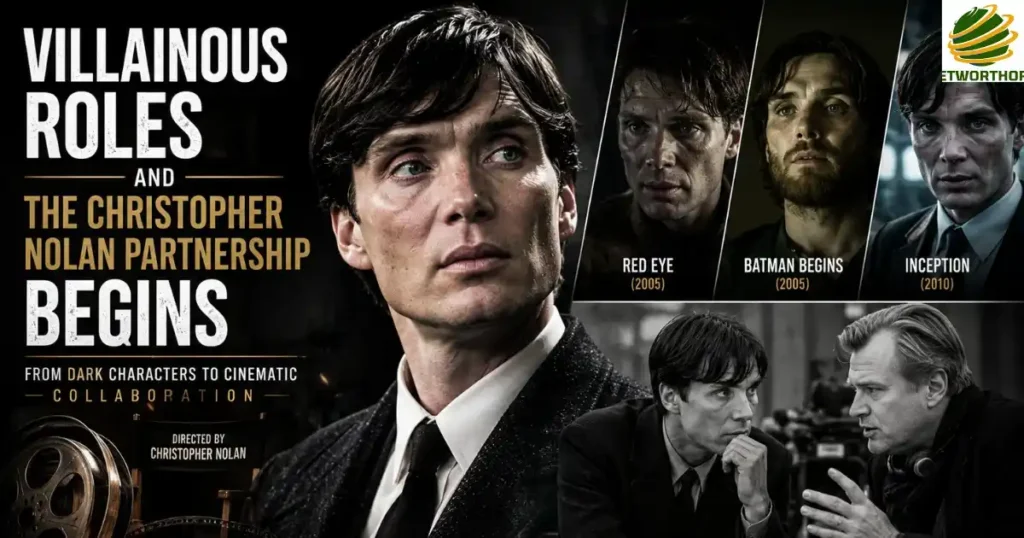
The year 2005 was transformative for Cillian Murphy’s career. It brought him two significant villainous roles that would define his public image for years to come and, most importantly, began his landmark collaboration with filmmaker Christopher Nolan.
Christopher Nolan was developing Batman Begins, the first installment of what would become the acclaimed Dark Knight trilogy. Murphy, already a fan of Nolan’s earlier films including Following and Memento, was among approximately ten actors who auditioned for the role of Bruce Wayne and his superhero alter ego. Murphy has acknowledged that he was never really right for Batman — his slender build and relatively slight physical presence were not what the role required. Christian Bale ultimately won the part.
But Nolan recognized something in Murphy that was perfect for a different character entirely. Dr. Jonathan Crane, the psychiatrist at Arkham Asylum who uses fear toxins to terrorize his victims and whose alter ego is the supervillain Scarecrow, required an actor who could be simultaneously credible as an intellectual and genuinely unsettling as a villain. Murphy’s piercing blue eyes, sharp angular features, and ability to project cold, calculated menace beneath a surface of professional composure made him ideal.
Batman Begins and the Scarecrow
Murphy’s approach to Scarecrow was rooted in character psychology rather than comic book theatrics. He played Dr. Crane as a real psychiatrist who happened to be deeply disturbed — controlled, articulate, and chillingly rational about his horrific experiments. The menace came not from shouting or physical intimidation but from a cold, almost clinical interest in his victims’ fear. When Crane donned the burlap mask and became Scarecrow proper, Murphy’s voice work and physical transformation made the character genuinely frightening without resorting to exaggeration.
Nolan told Spin magazine that Murphy had the most extraordinary eyes, and that he kept inventing excuses to have him take his glasses off in close-ups. It was the kind of directorial observation that speaks to the power of Murphy’s screen presence — the sense that his face, and particularly those piercing blue eyes, communicated something beyond ordinary acting.
Batman Begins was a critical and commercial triumph, revitalizing a franchise that had nearly destroyed itself with Batman and Robin. Murphy’s Scarecrow provided the film’s most genuinely frightening moments, demonstrating that Nolan’s grounded, realistic Gotham could accommodate serious psychological horror alongside action spectacle.
Red Eye and Hollywood Villain Status
The same year as Batman Begins, Murphy appeared in Wes Craven’s thriller Red Eye, playing Jackson Rippner, a charming sociopath who terrorizes Rachel McAdams’s character during an overnight flight. The New York Times critic Manohla Dargis described Murphy as a picture-perfect villain, noting that his blue eyes looked cold enough to freeze water and that his wolfish intensity suggested its own particular terrors. The film was a solid commercial success, earning nearly one hundred million dollars worldwide.
Entertainment Weekly ranked Murphy among its 2005 Summer MVPs, describing him as one of ten entertainers with outstanding breakthrough performances. The New Yorker’s David Denby wrote that Cillian Murphy, with his angelic looks that could turn sinister, was one of the most elegantly seductive monsters in recent movies. Murphy was receiving recognition not just as an actor but as a specific kind of screen presence — someone who could occupy the space between attractive and terrifying in a way that few performers could manage.
Murphy received several awards nominations for his 2005 villainous roles, including a nomination as Best Villain at the MTV Movie Awards for Batman Begins. But even as Hollywood was celebrating him as a villain, Murphy was about to demonstrate that he was far more than that.
Breakfast on Pluto: Daring and Transformative
Perhaps the boldest role of Murphy’s mid-2000s period was Patrick “Kitten” Braden in Neil Jordan’s comedy-drama Breakfast on Pluto, released in 2005. Based on Patrick McCabe’s novel of the same name, the film followed Kitten — a transgender Irish woman — on a journey through 1970s Ireland and London, set against the backdrop of IRA violence and the particular social conservatism of that era.
Murphy had actually auditioned for the role back in 2001, and though Jordan liked him for the part, the director was initially hesitant to revisit transgender and IRA-related themes so soon after his earlier work. Murphy lobbied Jordan persistently over several years, recognizing that the role was something extraordinary. In 2004, he prepared for the character by meeting with a transvestite who dressed him and took him out, helping him understand the experience from the inside.
The performance required Murphy to fully inhabit Kitten’s femininity, her resilience, her dark humor, and her profound longing, all without reducing the character to caricature or stereotype. Murphy played Kitten with a bemused and hopeful voice, as Roger Ebert put it — a character who was naive but savvy, wounded but determined, tragic but never pitiful. It was a brave and sensitive performance that demonstrated an empathy and range far beyond what audiences had seen from him previously.
Critics were largely enthusiastic. Murphy received a Golden Globe Award nomination for Best Actor in a Musical or Comedy for Breakfast on Pluto — significant recognition that confirmed his ability to carry complex, unconventional material with grace and authenticity. He also won the fourth Irish Film and Television Academy Best Actor Award for the performance.
The Wind That Shakes the Barley: Political Cinema at its Finest
Immediately following Breakfast on Pluto, Murphy starred in Ken Loach’s The Wind That Shakes the Barley, a film examining the Irish War of Independence and the subsequent Civil War through the story of two brothers on opposite sides of the conflict. Murphy played Damien O’Donovan, a young doctor who abandons a medical career in England to join the IRA and fight for Irish independence, only to watch his revolutionary ideals collide with brutal and tragic reality.
The role required Murphy to convey political radicalization without losing the character’s essential humanity. Damien begins as an idealistic young man and gradually hardens into someone capable of terrible acts in service of what he believes is a just cause. Murphy navigated this transformation with remarkable precision, showing how circumstances and conviction can transform a decent person into someone who does things that are very far from decent.
Working with Ken Loach, known for his naturalistic directing style and his practice of withholding full scripts from actors to encourage spontaneous reactions, pushed Murphy in new directions. The experience demanded a different kind of preparation and presence than studio filmmaking, and Murphy rose to the challenge with distinction.
The Wind That Shakes the Barley won the Palme d’Or at the 2006 Cannes Film Festival — the festival’s highest award — giving Murphy his first association with that level of critical prestige. GQ magazine presented Murphy with its 2006 Actor of the Year award. Kenneth Turan of the Los Angeles Times wrote that Murphy was especially good at playing the zealotry as well as the soul-searching and the regret, at showing us a man who is eaten up alive because he is forced to act in ways that are contrary to his background and training.
Together, Breakfast on Pluto and The Wind That Shakes the Barley demonstrated something that would become a hallmark of Murphy’s career: his ability to inhabit completely different worlds and completely different kinds of characters within a single year. One film placed him in drag, wearing makeup and embracing flamboyance; the other cast him as a revolutionary fighter hardened by war. The range was extraordinary, and it was entirely real.
Cillian Murphy and Christopher Nolan: A Partnership for the Ages
By the time Cillian Murphy appeared as the Shivering Soldier in Dunkirk in 2017, he had worked with Christopher Nolan on five separate films. This was a director-actor collaboration of unusual depth and consistency, rivaling the celebrated partnerships of Scorsese and De Niro or Truffaut and Leaud in its creative fruitfulness and mutual trust.
What made the Nolan-Murphy partnership work so effectively? Both men shared a set of aesthetic values that went beyond surface preferences. Nolan preferred practical effects and real locations over CGI, valued intellectual complexity in commercial storytelling, and took creative risks while consistently respecting the audience’s intelligence. Murphy shared all of these preferences and added to them a disciplined professionalism that made him one of the most reliable collaborators in the industry. Neither man cultivated a celebrity persona or confused fame with artistic achievement. Both let their work speak for itself.
Inception: Playing Robert Fischer
In 2010, Nolan cast Murphy in Inception as Robert Fischer, the heir to a massive business empire whose mind is infiltrated by Leonardo DiCaprio’s character Cobb in an elaborate scheme of corporate espionage through dream architecture. It was not a leading role, but it was a crucial one, because the entire emotional logic of the film depended on audiences caring about what happened to Fischer.
Murphy’s Fischer was grief-stricken over his father’s death, desperate for a connection and approval that his father had never offered. The vulnerability he brought to the character made the dream sequences emotionally resonant rather than merely visually spectacular. The film’s climactic sequences, in which Fischer confronts his dying father in a dream within a dream, required Murphy to convey complicated feelings about parental love, disappointment, and reconciliation. He delivered with complete conviction.
Inception became another massive Nolan success, earning over eight hundred and twenty-nine million dollars worldwide and winning four Academy Awards. Murphy’s supporting performance contributed significantly to the film’s emotional weight. It was further proof that he could make audiences invest in any character, regardless of the amount of screen time available.
Dunkirk: Wordless Performance and the Weight of Trauma
Nolan’s 2017 war film Dunkirk gave Murphy perhaps his most minimalist role in their entire collaboration. Credited simply as the Shivering Soldier, he played a traumatized British serviceman rescued from a sinking ship, whose psychological breakdown threatens everyone on the small civilian vessel attempting to help with the evacuation.
With minimal dialogue — the character is initially catatonic and then communicates primarily through panic and desperation — Murphy had to convey the complete psychological disintegration of someone who has witnessed too much violence and horror to function normally. His performance was almost entirely physical: trembling hands, hollow eyes, the bodily manifestation of trauma so severe that rational thought becomes impossible.
Murphy prepared for the role by researching shell shock and what would now be called post-traumatic stress disorder, understanding that the Shivering Soldier represented not just one fictional individual but thousands of men who returned from the First and Second World Wars fundamentally broken. His performance was devastating in its specificity and its honesty, adding a layer of psychological truth to the film’s meditation on courage and survival.
Dunkirk earned over five hundred and twenty-six million dollars worldwide and won three Academy Awards. Murphy’s wordless performance garnered critical praise that recognized it as far more than a cameo — it was a complete character study compressed into a handful of scenes.
The Dark Knight Trilogy: Scarecrow Across Three Films
Murphy’s return as Scarecrow in The Dark Knight in 2008 and The Dark Knight Rises in 2012 cemented his unique position in the trilogy. His appearance in The Dark Knight was brief — a cameo in the opening sequence — but his willingness to return for such a small role demonstrated the collaborative spirit and ego-free professionalism that made him such a valuable long-term creative partner for Nolan.
By appearing as Scarecrow in all three films of the trilogy, Murphy became the only villain to span the entire saga — a distinction that reflects both the character’s importance to Nolan’s vision and Murphy’s reliability as a collaborator. The Dark Knight, of course, became a cultural phenomenon driven largely by Heath Ledger’s posthumous Oscar-winning performance as the Joker. Murphy’s Scarecrow was a small part of something enormous, and his willingness to participate without ego further strengthened his bond with Nolan.
Peaky Blinders: Cillian Murphy as Tommy Shelby
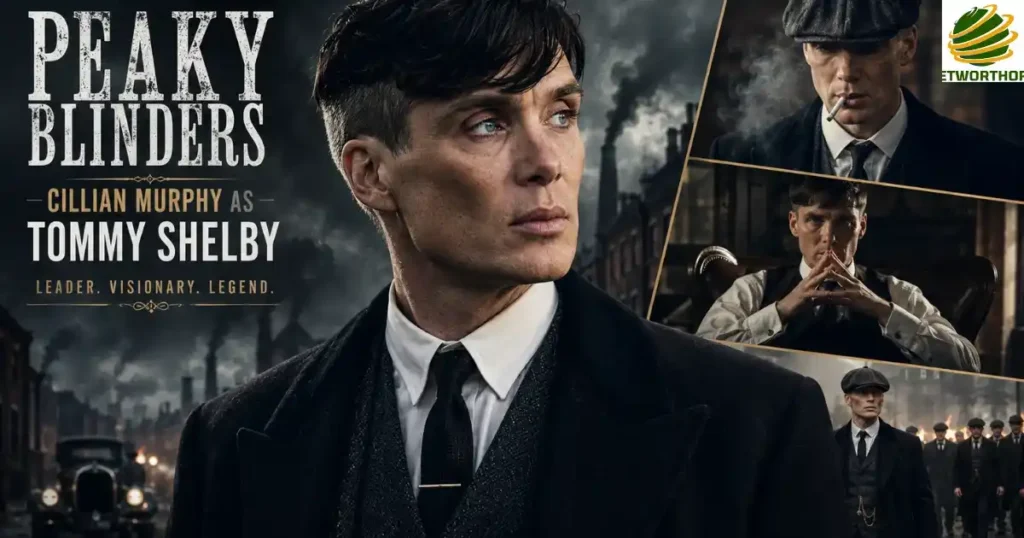
If 28 Days Later introduced Cillian Murphy to international audiences and the Batman films established his Hollywood profile, it was Peaky Blinders that transformed him into a genuine global icon. Beginning in 2013 and running for six seasons and thirty-six episodes through 2022, the BBC period crime drama created by Steven Knight gave Murphy the role of a lifetime: Thomas Michael Shelby, the enigmatic, damaged, brilliantly ruthless leader of a Birmingham criminal gang in the aftermath of the First World War.
The casting story is itself revealing. Steven Knight, creating the show, initially approached Jason Statham for the role. Statham was the obvious choice — a physically imposing action star whose screen presence suggested exactly the kind of dangerous competence that Tommy Shelby required. Murphy was a less obvious choice, and Knight met with both actors before making his decision. What changed his mind was a text message that Murphy sent him after their meeting. The message said simply: Remember, I’m an actor. Knight later admitted he had been stupid enough not to understand that initially, but the message crystallized what he needed. Murphy was cast.
The Creation of Tommy Shelby
Tommy Shelby is one of the most fully realized characters in contemporary television, and much of that achievement belongs to Murphy’s performance. On the surface, Tommy is all carefully cultivated image: the distinctive flat-cap haircut, the long overcoat, the ever-present cigarette, the flat Birmingham accent delivered in clipped, measured sentences. He speaks as little as possible. He maintains an expression of constant calculation, as though he is always three moves ahead of everyone else in the room.
But Murphy’s genius in the role was to make visible the psychological wreckage beneath Tommy’s controlled exterior. This is a man who survived the tunnels of France during the First World War and came back fundamentally broken. He self-medicates with opium and alcohol. He suffers nightmares and dissociative episodes. He is capable of extraordinary violence not because he enjoys it but because the war taught him that human life is fragile and cheap. Murphy played Tommy as someone who has built an armor of cold rationality specifically because underneath that armor he is barely holding himself together.
The physicality Murphy created for Tommy became instantly recognizable across the world: the particular way he walks with his hands in his pockets, slightly hunched; the sidelong glances that assess every room for threats; the minimal facial expressions that force the viewer to read everything in the eyes; the way he uses cigarettes as both prop and coping mechanism. It was an incredibly controlled, precise performance that never felt studied or artificial, always alive and present.
Tommy Shelby’s Psychological Depth
What made Tommy Shelby resonate so deeply with global audiences was the extraordinary complexity that Murphy maintained across six seasons and nine years. Tommy is a socialist who becomes a capitalist. He is a devoted family man who consistently puts his family in mortal danger. He is working-class in his origins but aspires desperately to aristocratic respectability. He is profoundly traumatized but functions with what appears to be effortless competence. He is cold and calculating but capable of explosive, almost animal violence when pushed beyond a certain point.
Murphy never simplified these contradictions or resolved them artificially. He let them coexist, season after season, making Tommy endlessly fascinating to watch precisely because he could not be reduced to a simple moral category. The romantic relationships Tommy navigated throughout the series — with Grace, with May, with Lizzie, and others — further revealed different dimensions of his character. With each woman, Murphy showed different aspects of Tommy’s interior life, from tender vulnerability to cold manipulation, making you understand both why people are drawn to Tommy and why he ultimately destroys everything he touches.
The character’s management of his own PTSD — through alcohol, opium, work, violence, and occasional moments of genuine connection — was handled with unusual sensitivity for a mainstream genre drama. Murphy’s performance made Tommy’s psychological struggles feel real and contemporary rather than merely period-appropriate, which is a significant reason why the show resonated so powerfully with audiences who had no particular interest in 1920s Birmingham.
Peaky Blinders: Cultural Impact and Global Phenomenon
Peaky Blinders premiered on BBC Two in 2013 to decent but not spectacular ratings. The transformation into a global phenomenon came when Netflix acquired international distribution rights and made the show available to audiences worldwide. Suddenly, people from Japan to Brazil to the United States were obsessed with Tommy Shelby and the Peaky Blinders gang.
The cultural impact extended far beyond viewership statistics. The Peaky Blinders haircut — closely cropped on the sides with length on top — became one of the most requested styles in barbershops around the world. Flat caps and three-piece suits experienced a significant fashion renaissance. Bars created Peaky Blinders-themed cocktails and menus. Fashion designers referenced the show’s aesthetic in their collections. The Tommy Shelby character became a modern masculine archetype: the damaged but functional man, simultaneously vulnerable and dangerous, stylish but not vain, intelligent and ruthless.
Social media amplified the show’s cultural reach in ways that traditional television rarely experiences. Gif sets of Tommy’s most memorable moments spread across every platform. Instagram accounts dedicated to Peaky Blinders style accumulated millions of followers. TikTok creators made content analyzing Tommy’s psychology, recreating his looks, and discussing the show’s themes. The show’s distinctive use of contemporary music — artists like Nick Cave, Arctic Monkeys, and PJ Harvey — in its 1920s setting created a sonic identity that Murphy’s performance anchored perfectly.
Murphy’s own image became part of the cultural landscape in unexpected ways. The Disappointed Cillian Murphy meme — capturing a particular expression of slightly bemused resignation — became one of the internet’s most versatile reaction images. Murphy himself seemed genuinely bemused by this development, telling interviewers in 2017 that he did not even know what a meme was.
Awards and Recognition for Peaky Blinders
Murphy received consistent critical praise for his work in Peaky Blinders across all six seasons, earning nominations from BAFTA Television and winning multiple Irish Film and Television Awards for Best Actor in a Lead Role. Critics consistently noted how Murphy’s performance elevated the show’s occasionally heightened writing, finding emotional truth in dialogue that could sometimes veer toward self-parody if delivered by a less committed actor.
The show itself won BAFTA Awards and National Television Awards across its run, including three National Television Awards for best drama or best returning drama in 2019, 2020, and 2022. Murphy personally won two National Television Awards for best drama performance in 2020 and 2022, recognizing his sustained excellence across what had become one of the longest-running and most beloved British drama series of the decade.
Peaky Blinders: The Immortal Man
In 2026, Murphy reprised his role as Tommy Shelby in Peaky Blinders: The Immortal Man, the feature film continuation of the series. The film, set in Birmingham in 1940 against the backdrop of the Second World War and the rise of fascism, sees Tommy forced to confront his own legacy and decide whether to face his demons or burn everything to the ground. The film starred Murphy alongside Barry Keoghan, Rebecca Ferguson, and Stephen Graham, and was released in select theaters in March 2026 before heading to Netflix streaming.
For Murphy, returning to Tommy Shelby represented coming full circle — bringing closure to a character he had inhabited across nine years of television and one feature film, delivering what he hoped would be the definitive conclusion to Tommy’s extraordinary story.
Oppenheimer: The Oscar-Winning Performance
The collaboration between Cillian Murphy and Christopher Nolan reached its apex in 2023 with the release of Oppenheimer, a biographical thriller examining the life of J. Robert Oppenheimer, the theoretical physicist who led the Manhattan Project and is often called the father of the atomic bomb. After supporting roles in five Nolan films spanning nearly two decades, Murphy finally received the lead role — and he made the most of it in the most spectacular fashion imaginable.
The casting decision was, according to Nolan, honestly one of his favorite moments in the movie business. Two decades of working together had given Nolan absolute confidence in Murphy’s ability to anchor a three-hour historical drama about theoretical physics, moral philosophy, political persecution, and the most consequential scientific achievement — and moral catastrophe — of the twentieth century. Murphy was the obvious choice, but the obviousness was itself a product of years of accumulated trust.
Preparation and Physical Transformation
Murphy approached the role of Oppenheimer with the thoroughness that characterizes all of his most significant performances. He read the authoritative Oppenheimer biography American Prometheus by Kai Bird and Martin Sherwin multiple times. He studied recordings of Oppenheimer’s distinctive speaking voice and physical mannerisms. He worked extensively on his American accent, knowing that any inauthenticity in the vocal performance would undermine the character’s intellectual credibility.
Physically, Murphy underwent a significant transformation. He lost a substantial amount of weight to match Oppenheimer’s gaunt, almost emaciated appearance — the look of a man who forgets to eat because he is so consumed by his work and, later, by his guilt. At forty-six years old during filming, Murphy pushed his body to embody a man quite literally consumed by what he had created. The hollowed-out look became central to the performance: Oppenheimer as someone physically manifesting the internal weight of his moral burden.
Murphy also took inspiration from David Bowie’s appearance in the 1970s when considering Oppenheimer’s particular kind of otherworldly, almost alien charisma. It was an unexpected but entirely successful reference point — both men possessed a quality of seeming to be slightly out of phase with ordinary human reality, too brilliant and too strange to be entirely comfortable in the world of normal people.
The Performance
The film’s structural complexity — interweaving Oppenheimer’s life story, the development of the atomic bomb at Los Alamos, and two separate legal and political hearings challenging his loyalty — required Murphy to portray the character across radically different time periods and psychological states. The young, confident, almost arrogant theoretical physicist of the 1930s and early 1940s differs profoundly from the haunted, guilt-consumed creator of the bomb, who differs again from the defiant but worn man defending his reputation and legacy before hostile government committees.
Murphy’s approach focused consistently on Oppenheimer’s essential loneliness. Despite surrounding himself with brilliant collaborators at Los Alamos and despite his fame, Oppenheimer existed in a kind of intellectual and moral isolation. He saw further than the people around him — including the full implications of what he was creating — and was condemned to live with that foresight while everyone else celebrated the achievement. Murphy conveyed this with extraordinary subtlety, using economy of expression and a quality of focused, inward attention that made you feel you were watching a man constantly calculating the weight of consequences.
The Trinity test sequence — where Oppenheimer watches the first successful detonation of an atomic device — showcases Murphy’s ability to hold multiple emotional states simultaneously. In the seconds of watching that explosion, you see pride, horror, awe, wonder, and the crushing weight of responsibility all moving across his face at once. It is one of the great pieces of screen acting of the contemporary era.
The famous moment in which Oppenheimer quotes the Bhagavad Gita — Now I am become Death, destroyer of worlds — becomes devastating not because Murphy plays it dramatically but because he makes it feel like a man recognizing an awful, inescapable truth about himself. It is quiet, interior, and all the more powerful for that restraint.
The Barbenheimer Phenomenon
In summer 2023, Oppenheimer was released on the same day as Greta Gerwig’s Barbie, creating an internet sensation that became known as Barbenheimer. The stark tonal contrast between the two films — a serious three-hour historical drama about the atomic bomb and a cheerfully subversive comedy starring Margot Robbie as the iconic doll — inspired moviegoers to see both on the same day as a kind of cinematic adventure, generating unprecedented social media engagement and extraordinary box office results for both films.
For Murphy, who famously has no social media presence and prefers to stay as far from internet culture as possible, the Barbenheimer phenomenon was an accidental entrance into the digital conversation. Memes contrasting his intense Oppenheimer with Barbie’s cheerful pink world spread everywhere. Murphy seemed genuinely bemused by the whole thing in interviews but appreciated that it was bringing enormous audiences to what was, in content terms, a challenging and demanding film.
Oppenheimer exceeded all commercial expectations, earning nearly one billion dollars worldwide — an extraordinary figure for a three-hour historical drama about theoretical physics and political persecution. It became a genuine cultural event, with audiences around the world engaging seriously with its themes of scientific responsibility, political loyalty, and the moral weight of creating weapons of mass destruction.
The Awards Season Sweep
The awards season that followed the film’s release saw Murphy emerge quickly as the frontrunner for Best Actor. He won the Golden Globe Award for Best Actor in a Drama — his first Globe win after a nomination for Breakfast on Pluto nearly two decades earlier. The BAFTA Award followed, recognizing him as the best leading actor of the year in British and international cinema. The Screen Actors Guild Award came next, reflecting the esteem in which his fellow professional actors held the performance.
On March 10, 2024, Cillian Murphy won the Academy Award for Best Actor, becoming the first Irish-born performer ever to receive this honor. Standing on the Oscars stage at the Dolby Theatre in Hollywood, Murphy was characteristically understated in his acceptance, thanking Nolan for entrusting him with the role, acknowledging his wife and sons, and paying tribute to Oppenheimer himself with intelligence and empathy — describing him as a complicated man who made difficult choices.
Empire magazine’s Dan Jolin had written that at the film’s pulsing nucleus was Murphy as Oppenheimer, and that he was compelling throughout. The New York Times called his performance mesmerizing. Rolling Stone described it as bringing Oppenheimer to life with Shakespearean tragic weight. The consensus was unanimous: this was not just a good performance in a good film but a career-defining achievement by one of the great actors of his generation.
Cillian Murphy’s Personal Life: Marriage, Family, and Privacy
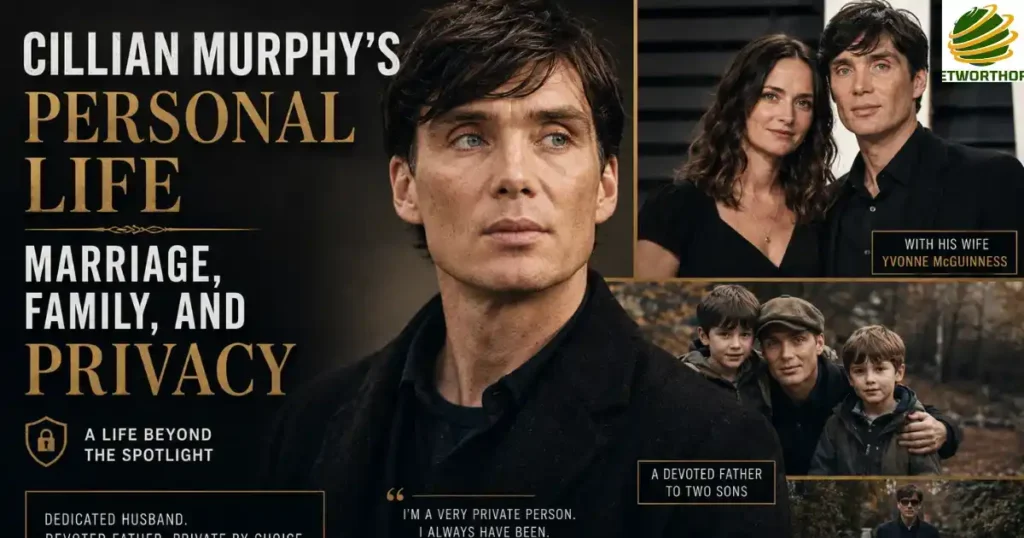
Understanding Cillian Murphy requires understanding his personal life, not because he has made it available for public consumption — he has done precisely the opposite — but because the values and choices reflected in his private life illuminate everything about why his career has taken the shape it has.
Murphy met his wife, Yvonne McGuinness, in 1996 at one of his band’s rock concerts. At the time, he had just been cast in Disco Pigs and was still primarily thinking of himself as a musician. McGuinness, a classically trained visual artist from Kilkenny, Ireland, who works primarily in video installations and performance art, recognized something special in Murphy immediately. Their relationship developed as McGuinness accompanied Murphy on the Disco Pigs international tour, and the partnership they built during those early years of struggle and discovery has endured for nearly three decades.
They married on August 1, 2004, in a private ceremony that reflected both their personalities — intimate, away from media attention, focused entirely on their relationship and their families rather than on any public performance of commitment. The marriage has lasted over twenty years in an industry notorious for destroying relationships under the combined pressures of fame, physical separation, ego, and the constant availability of alternative temptations.
Yvonne McGuinness: The Woman Behind the Actor
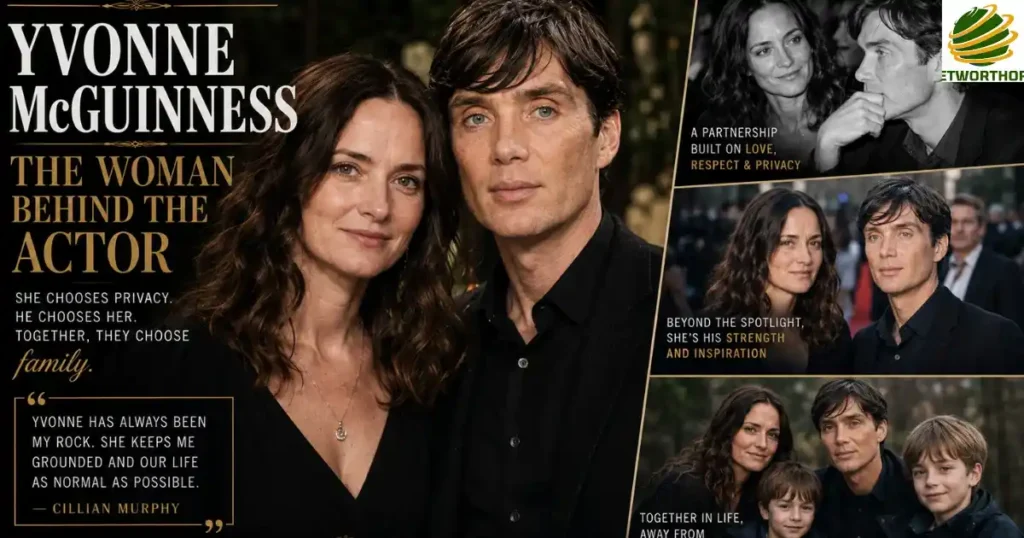
McGuinness’s own success as an artist — she has exhibited internationally, including at the Tate Modern in London — means she brings to the partnership a genuine understanding of the creative process and the demands of a life built around artistic work. She is not a celebrity wife defined by her husband’s fame but a substantial creative talent in her own right, which has given their partnership a quality of mutual respect and shared understanding that many celebrity relationships lack.
Murphy has spoken warmly about McGuinness’s role in keeping him grounded during the years of rapidly increasing fame in the mid-2000s. He told People magazine that it was very important to have someone like that, and that his life had not changed in any meaningful way because of fame — he still had the same friends and went to the same places. This grounding, which reflects McGuinness’s influence as much as Murphy’s own disposition, has been fundamental to his ability to navigate success without losing himself.
Cillian Murphy’s Children
Murphy and McGuinness have two sons, Malachy and Aran. Malachy was born in 2005 and Aran in 2007. The couple has been fiercely protective of their children’s privacy throughout their lives — photographs of the boys are extremely rare, their exact birthdates have not been confirmed publicly, and Murphy consistently refuses to discuss them in any specific terms during interviews. He understands that sharing details about his children would be a betrayal of their right to privacy and a contradiction of everything he values about keeping his personal life separate from his public work.
Murphy has acknowledged that fatherhood changed his priorities significantly. It made him more selective about the projects he accepted, more attentive to the amount of time he spent away from home, and more conscious of the need to be present in his children’s lives in a way that his career ambitions could easily have prevented. He has described wanting his sons to have normal Irish childhoods — going to local schools, playing with neighborhood friends, living without the distortions and pressures that come with being the children of a famous parent.
Living in Dublin: A Choice That Defines His Values
In 2015, after years of living in London, Murphy and his family made the decision to move back to Dublin. This was not a career necessity but a values choice, and it surprised many observers. Actors at Murphy’s level of success typically maintain bases in Los Angeles, London, or other centers of the entertainment industry. Murphy chose Dublin because he wanted his family rooted in Irish culture, wanted his sons educated in Irish schools and surrounded by Irish community, and wanted his own life to maintain a genuine connection to his origins and his identity.
The move was also, in a quieter way, a statement about his vision of success. Murphy did not move back to Dublin because his career was failing — it was, at that point, in excellent shape. He moved back because he valued his family’s quality of life, his children’s connection to their cultural heritage, and his own psychological groundedness more than he valued the professional convenience of proximity to Hollywood power centers.
Dublin has treated him with the reserved respect that he needs. He can walk through the city, do his grocery shopping, take his sons to school, and maintain friendships from long before fame arrived, all without being mobbed or constantly surveilled. This relative normalcy has been essential to his ability to sustain creativity and personal authenticity across a career now spanning three decades.
Cillian Murphy’s Philosophy of Privacy
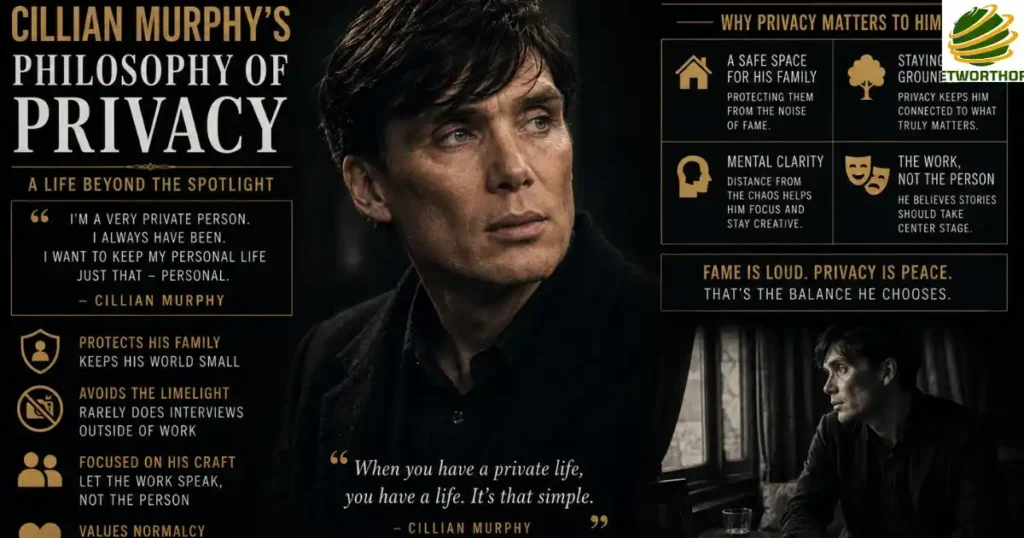
In an era of social media oversharing and the monetization of personal life, Murphy’s approach to privacy is almost startlingly old-fashioned. He has no Instagram, no Twitter, no TikTok, no Facebook, no social media presence of any kind. He gives relatively few interviews and consistently deflects personal questions with polite but firm firmness. He has been clear about why: he believes his personal life is irrelevant to audiences, that sharing private details would be a betrayal of his family’s trust, and that celebrity culture’s demand for personal disclosure is something he finds both unappealing and unnecessary.
This approach is not strategic positioning — it is not a calculated form of mystique-building designed to enhance his appeal. It reflects a genuine belief that the work should speak for itself and that the actor’s private self has no obligation to become public property simply because the actor’s professional work is visible to millions of people. It is a distinction that seems obvious when articulated but that very few public figures in the contemporary entertainment industry actually maintain.
Cillian Murphy’s Acting Style and Approach to Performance
What distinguishes Cillian Murphy as an actor is not any single technique or signature mannerism but rather a quality of complete presence and genuine commitment that he brings to every role, regardless of its scale or commercial importance. Directors who have worked with him consistently describe the same qualities: thorough preparation, ego-free professionalism, complete commitment to character, and a generosity toward fellow actors that makes him an ideal scene partner.
Murphy’s approach to character preparation is thorough but not dogmatic. He is not a method actor in the traditional sense — he does not stay in character between takes, does not demand to be called by his character’s name on set, and does not confuse the intensity of the preparation process with the character itself. Instead, he focuses on deep psychological understanding of who the character is, thorough research into the historical and social context in which the character lives, and a careful attention to the physical details — voice, posture, movement, gesture — that make a character inhabitable from the inside out.
For Oppenheimer, this meant reading American Prometheus multiple times, studying recordings of Oppenheimer’s voice and speech patterns, researching quantum mechanics sufficiently to discuss it credibly, and physically transforming through significant weight loss. For Tommy Shelby, it meant researching post-World War I trauma and its effects, studying 1920s Birmingham social history, developing a specific Birmingham accent, and creating a precise physical vocabulary for the character. For the Shivering Soldier in Dunkirk, it meant researching shell shock and PTSD to understand the phenomenology of severe psychological trauma and how it manifests physically.
Theater Training as Foundation
Murphy credits his theater training, particularly his years with Corcadorca Theatre Company and his work with Enda Walsh, as the foundation for everything he has achieved in film. Theater taught him discipline — the understanding that you cannot rely on another take or on editing to fix a performance; you have to get it right every night, which demands a level of preparation and consistency that film does not automatically require. Theater taught him vocal and physical control, the ability to project character through the body as much as through the face. Theater taught him ensemble collaboration, the art of listening and responding genuinely to what other actors are doing rather than simply executing a planned performance.
Murphy returns to theater periodically throughout his career specifically to maintain these skills and to prevent the slight laziness that film can encourage in even the most committed actors. His 2011 one-man show Misterman, written and directed by Enda Walsh, required him to sustain a demanding performance entirely alone for over an hour every night. The discipline required for that kind of work keeps other aspects of his craft sharp.
Versatility as Defining Characteristic
What most clearly defines Murphy’s career as an actor is his genuine versatility — his ability to move convincingly between heroes and villains, between genre films and art-house dramas, between comedy and tragedy, between characters from different nations, social classes, historical periods, and psychological profiles. This range is not simply a matter of technical skill, though the technical skill is certainly there. It reflects something deeper: a genuine curiosity about human experience and a willingness to inhabit perspectives very different from his own without judgment.
He has played a pandemic survivor, a transgender woman, a revolutionary fighter, a criminal gang leader, a physicist, a sociopathic airline terrorist, a traumatized war veteran, and dozens of other distinct human beings across twenty-five years of work. In each case, the performance feels inhabited rather than performed — a distinction that is easy to describe but very difficult to achieve.
Christopher Nolan has called Murphy the most versatile actor he has ever worked with. Danny Boyle has praised his naturalism and emotional availability. Ken Loach highlighted his professionalism and the complete absence of ego in his approach to collaborative work. Emily Blunt, who appeared with Murphy in Oppenheimer, described him as completely present and giving in every take — a scene partner who is genuinely interested in making the scene work rather than in making himself look good within it.
Cillian Murphy’s Complete Filmography: Notable Roles
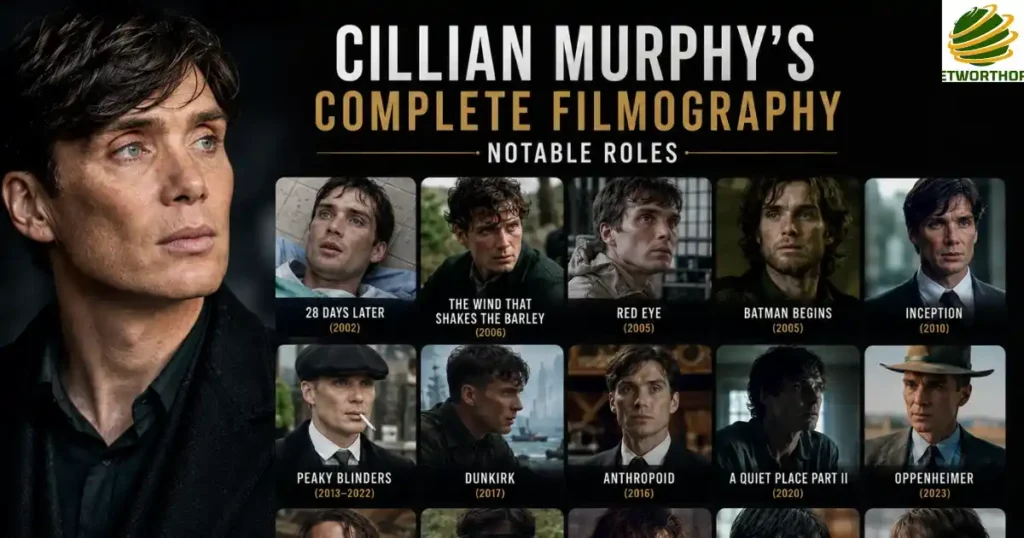
Across a career now spanning nearly three decades, Cillian Murphy has accumulated an extraordinary body of work that resists simple categorization. His filmography ranges from low-budget Irish independent films to billion-dollar Hollywood blockbusters, from experimental theater pieces to mainstream genre entertainment, from biographical drama to science fiction to psychological thriller. The common thread is not genre or scale but quality and commitment.
His early film work — On the Edge (2001), the film adaptation of Disco Pigs (2001), Intermission (2003) — established his ability to carry Irish material with authenticity and intelligence. His Hollywood breakthrough with 28 Days Later (2002) demonstrated his ability to anchor a commercial genre film while maintaining complete artistic credibility. His work with Nolan in Batman Begins (2005), Inception (2010), Dunkirk (2017), and Oppenheimer (2023) represents a sustained collaboration of extraordinary creative richness.
Beyond these landmark films, Murphy has maintained a consistent practice of appearing in smaller, more intimate productions that have kept his range active and his artistic instincts sharp. Red Lights (2012) paired him with Robert De Niro and Sigourney Weaver in a psychological thriller about paranormal investigation. Murphy has said that his first scene opposite De Niro required his character to be terrified and intimidated, and that he found he did not need to act — De Niro simply has that quality of presence that creates genuine awe in those around him.
Sunshine and Science Fiction
Danny Boyle and Murphy reunited for Sunshine in 2007, a science fiction thriller in which an ensemble cast including Murphy, Chris Evans, Rose Byrne, and Michelle Yeoh plays astronauts on a mission to reignite the dying sun and save humanity. Murphy played Capa, the crew’s physicist — the person on whom the mission’s ultimate success depended. The role required him to project a believable scientific intelligence, and he succeeded convincingly, making you believe that this character genuinely understands things about the universe that ordinary people cannot access.
Sunshine was not a major commercial success on its initial release, receiving mixed reviews and performing modestly at the box office. But it has since developed a devoted following, recognized as a visually and philosophically ambitious film that asked genuine questions about human purpose and sacrifice. Murphy’s performance is one of its central strengths.
A Quiet Place Part II and the Horror Genre
Murphy appeared in John Krasinski’s horror sequel A Quiet Place Part II in 2021, playing Emmett, a hardened survivor and old family friend of the Abbott family who initially refuses to help the family after losing his own loved ones but gradually rediscovers his humanity through his connection with Regan Abbott, played by Millicent Simmonds. It was a significant departure from his Peaky Blinders work — a physically demanding genre role that required him to be both menacing and ultimately sympathetic.
Peter Bradshaw of The Guardian praised his performance, recognizing how Murphy brought his characteristic intensity to a genre context without allowing the character to become a type. Emmett’s journey from traumatized isolation to reluctant heroism was handled with the psychological specificity that Murphy brings to all his work.
Small Things Like These: Producer and Star
Small Things Like These, based on Claire Keegan’s acclaimed novella, marked Murphy’s most significant foray into film production to date. He starred as Bill Furlong, a coal merchant and devoted family man in 1980s Ireland who begins to discover disturbing truths about the local convent’s operation of a Magdalene laundry — one of the institutions where the Irish Catholic Church forcibly confined and exploited thousands of unmarried mothers throughout the twentieth century.
Murphy produced the film through his production company Big Things Films, which he co-founded with producer Alan Moloney in early 2024. The decision to both produce and star in Small Things Like These reflects Murphy’s deepening commitment to shaping Irish stories for the screen rather than simply performing in them. The film addresses a dark chapter in Irish history that demanded honest, unflinching artistic treatment, and Murphy used his industry standing to ensure it got made.
28 Years Later: Return to Where It Began
2026 brings Murphy back to the post-apocalyptic world that launched his international career. 28 Years Later, directed by Danny Boyle with a script by Alex Garland, revisits the world of 28 Days Later nearly a quarter-century after the original film. Murphy serves as executive producer on the project and reprises his role as Jim in the sequel’s second installment, 28 Years Later: The Bone Temple, bringing his character back after an absence of over two decades of in-universe time.
The project represents a profound full-circle moment in Murphy’s career — returning to the franchise and the director who first brought him to global attention, at a point when his industry standing and artistic achievements have transformed him from a promising newcomer into one of the most respected actors in the world.
Cillian Murphy’s Awards and Honors: A Career of Recognition
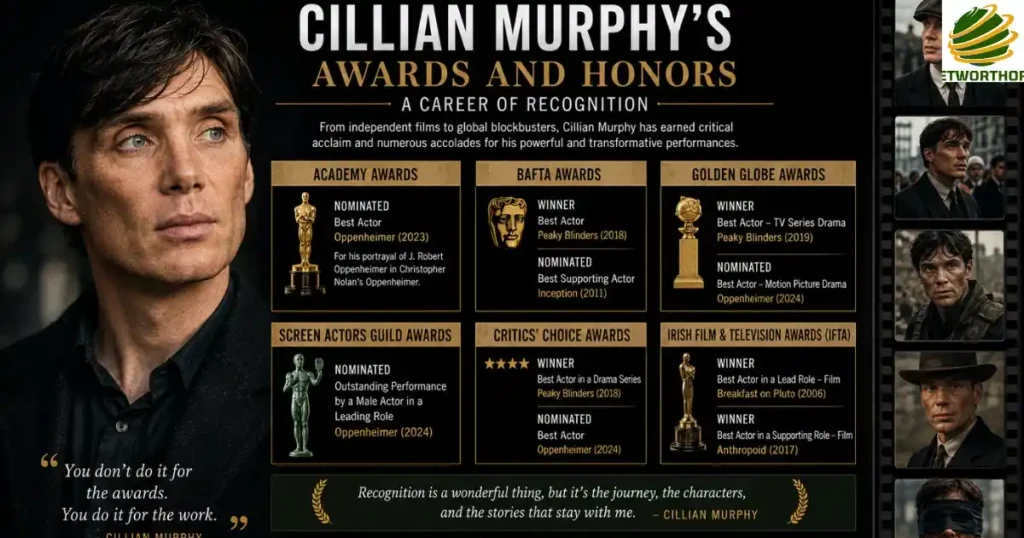
The formal recognition that Cillian Murphy has received across his career accurately reflects the sustained excellence of his work, even if the most significant honors came relatively late relative to the quality of the performances that preceded them. The Academy Award for Best Actor in 2024 was, in many respects, long overdue — a belated but entirely deserved acknowledgment of an actor who had been delivering extraordinary work for more than two decades.
His complete awards record encompasses the Academy Award for Best Actor for Oppenheimer in 2024; the BAFTA Award for Best Actor in a Leading Role for Oppenheimer in 2024; the Golden Globe Award for Best Actor in a Motion Picture Drama for Oppenheimer in 2024; the Screen Actors Guild Award for Outstanding Performance by a Male Actor in a Leading Role for Oppenheimer in 2024; and a Golden Globe nomination for Best Actor in a Musical or Comedy for Breakfast on Pluto in 2006.
In television, he won multiple Irish Film and Television Awards for Best Actor in a Lead Role for Peaky Blinders and won two National Television Awards for Best Drama Performance in 2020 and 2022. In theater, he received an Irish Times Theatre Award for Best Actor for Misterman in 2011 and a Drama Desk Award nomination for Outstanding Solo Performance for the same production’s New York run in 2012.
He won the Empire Award for Best Newcomer for 28 Days Later in 2003 and the GQ Actor of the Year Award in 2006 for The Wind That Shakes the Barley. He received an Irish Film and Television Award for Best Actor for Breakfast on Pluto in 2006. In 2023, the Irish postal service An Post issued a stamp featuring Murphy as part of their Irish Film series — an honor typically reserved for the most significant Irish cultural figures, reflecting his status as a genuine national treasure.
Cillian Murphy’s Activism and Social Engagement
Murphy’s engagement with social and political issues is selective, thoughtful, and consistent with the values that have defined his entire approach to public life. He does not engage in performative activism or use social causes as a form of brand management. When he speaks up about an issue, it is because he genuinely cares about it, and his involvement tends to be substantive rather than merely symbolic.
In 2007, he participated in the Rock the Vote Ireland campaign, encouraging young people to engage with the democratic process in the general election. His focus was on civic responsibility rather than partisan politics, reflecting his belief that democratic participation itself is a value worth defending regardless of particular political allegiances.
Murphy publicly supported the 2018 Irish referendum to repeal the eighth amendment to the Irish constitution, which had restricted access to abortion. He appeared on a podcast specifically to urge men to support women and vote in favor of the referendum, engaging directly with the argument that reproductive rights were a matter of fundamental dignity that transcended conventional political positioning. For an Irish actor navigating an international career, taking a clear position on a contested domestic political issue was a meaningful choice.
He has been closely associated with Focus Ireland, a charity addressing homelessness, and has used his platform to raise awareness of Ireland’s housing crisis — a serious social problem that has affected Cork and Dublin, the cities most central to his own identity and experience. In 2011, he became a patron of the UNESCO Child and Family Research Centre at the University of Galway, reflecting his concern for children’s welfare and family policy.
In 2012, Murphy sent a message of support to the former Vita Cortex factory workers who staged a sit-in at their plant after the company attempted to deny them their full redundancy payments. His solidarity with working-class people fighting for basic economic justice reflected the values instilled in him by his Cork upbringing and his deep discomfort with economic exploitation.
Cillian Murphy’s Physical Appearance, Style, and Public Image
Cillian Murphy’s appearance is genuinely distinctive — distinctive enough to have shaped his career in significant ways, both by opening doors and by creating challenges. The most remarked-upon features are his eyes: a striking, piercing shade of blue that various journalists, directors, and co-stars have described as icy, otherworldly, laser-focused, or simply extraordinary. These eyes, combined with sharp cheekbones, a defined jawline, and features that have been variously described as androgynous, elegant, and almost unsettlingly beautiful, create a screen presence that is immediately memorable.
Christopher Nolan noted Murphy’s eyes when casting him as Scarecrow, saying he kept inventing excuses to have him take his glasses off in close-ups. Danny Boyle’s casting director commented on his dreamy, slightly de-energized, floating quality when he was filming 28 Days Later. The New Yorker described him as having angelic looks that could turn sinister. These responses from professionals who spend their working lives assessing how people look on screen suggest that Murphy’s appearance genuinely occupies an unusual territory — attractive and unsettling simultaneously, capable of projecting warmth and cold menace from the same features depending on context and intention.
Style and Fashion
Murphy’s personal style has evolved from the casual, slightly disheveled look of his theater years to a sophisticated, understated elegance that has brought him genuine recognition in fashion circles. In 2015, GQ named him to its list of fifty best-dressed men, recognizing his approach to red carpet appearances as impeccably calibrated to his personality: quality over flash, timeless over trendy, confident but never ostentatious.
His style philosophy mirrors his acting approach entirely: less is more, preparation matters more than improvisation, and authenticity is worth more than flash. He favors well-tailored suits in neutral colors, classic accessories, and minimal jewelry. Even at the Oscars ceremony, Murphy’s formal wear conveyed elegance without any suggestion of effort — the result of careful thought that conceals the thought entirely.
In 2024, Versace announced Murphy as the new face of their luxury Italian fashion brand, a partnership that made intuitive sense. Versace gets an Oscar winner with genuine aesthetic credibility and an international profile that transcends entertainment industry circles. Murphy gets access to fashion’s creative possibilities without compromising the carefully maintained image that his privacy and selectivity have constructed over decades.
Sex Symbol and Cultural Icon
Murphy has an unusual and somewhat bemused relationship with his status as a sex symbol. He has never actively cultivated it, has expressed genuine puzzlement at it in interviews, and seems to find the whole category slightly absurd when applied to himself. Yet his distinctive looks, combined with the dangerous charisma he brought to Tommy Shelby and the moral gravity he brought to Oppenheimer, have made him a heartthrob across multiple demographics, age groups, and national cultures.
The Tommy Shelby effect was particularly powerful in amplifying this aspect of his public image. The character’s combination of physical elegance, cold intelligence, and barely suppressed violence created an archetype that audiences worldwide found intensely compelling. Murphy’s indifference to his own sex symbol status — his refusal to play to the camera or cultivate the image — has, if anything, enhanced its power. In an era of carefully manufactured attractiveness, authenticity is irresistible.
Cillian Murphy’s Net Worth and Business Ventures
Murphy has never discussed his finances publicly, which is entirely consistent with his broader approach to privacy. Industry estimates place his net worth in the range of twenty to twenty-five million dollars as of 2026 — a figure that reflects both the substantial earnings from major commercial productions and a lifestyle that has never been oriented toward conspicuous consumption.
His work with Christopher Nolan on six films spanning nearly two decades would have provided significant income, with his Oppenheimer salary likely representing his largest single paycheck given his lead role in a major studio production. The Dark Knight trilogy paid well, though as a supporting player rather than a lead he would have earned less than Christian Bale. Peaky Blinders provided steady income across six seasons and nine years, with the show’s Netflix deal likely enhancing his earnings beyond the base BBC fees.
What is notable about Murphy’s wealth is primarily what he does not do with it. He does not collect expensive cars, does not maintain multiple luxury residences, does not spend money in any of the ways that entertainment industry wealth typically manifests. His Dublin home is comfortable but not palatial. He dresses well but does not accumulate designer wardrobes as status symbols. His wealth has provided him with security and, crucially, with the creative freedom to choose projects on the basis of artistic merit rather than financial necessity.
Big Things Films: Production Company
Murphy launched Big Things Films in February 2024 in partnership with producer Alan Moloney, signaling a meaningful expansion of his industry role beyond acting. The company’s focus is on Irish and European cinema with genuine artistic merit — the kind of storytelling that might not attract major studio backing without the involvement of a producer with Murphy’s reputation and relationships.
Small Things Like These represents the company’s first significant project, combining Murphy’s dual roles as producer and lead actor in a film addressing one of the darkest chapters in twentieth-century Irish history. The success of that film will likely determine the direction of Big Things Films’ development, but the commitment it represents is clear: Murphy intends to shape Irish cinema from the inside, not just perform in it from the outside.
Cillian Murphy in 2026: Current Projects and Future Direction
As of 2026, Cillian Murphy stands at one of the most interesting junctures in an already extraordinary career. The Academy Award has changed things — not in terms of his fundamental approach to his work, which remains constant, but in terms of the opportunities available to him and the industry standing from which he can advocate for projects and filmmakers he believes in.
Peaky Blinders: The Immortal Man has brought him back to Tommy Shelby for what promises to be the character’s final appearance, providing closure to a decade-long creative relationship with one of the most beloved fictional characters in contemporary television drama. 28 Years Later: The Bone Temple has reconnected him with Danny Boyle and the post-apocalyptic world of 28 Days Later, creating a profound symmetry between the film that first brought him to international attention and the current peak of his career.
His production work through Big Things Films continues to develop, with several projects reportedly in various stages of development. Murphy has expressed interest in supporting younger Irish filmmakers and using his industry leverage to help get difficult but important Irish stories made. This mentorship and advocacy role could become an increasingly significant part of his contribution to Irish and international cinema as he moves through his fifties.
Rumors and Future Nolan Collaboration
Industry speculation about another Christopher Nolan collaboration persists, fueled by the fact that their six-film partnership has been one of the most creatively fruitful director-actor relationships in contemporary cinema. Nolan has made clear in interviews that he considers Murphy one of his most essential collaborators, and Murphy has said that he would show up for Nolan even for the smallest role in any project the director chose to make. Whatever Nolan develops next will almost certainly find a place for Murphy somewhere in it.
Murphy’s future career trajectory will likely continue to follow the pattern that has served him so well for three decades: quality over quantity, artistic merit over commercial guarantee, Irish roots maintained alongside international ambition, personal integrity over celebrity performance. He has earned the right, through sustained excellence and principled consistency, to continue on exactly these terms. And based on everything he has produced so far, that is the best possible news for anyone who cares about cinema.
Cillian Murphy’s Legacy and Cultural Impact
Evaluating the legacy of an actor who is still, at fifty, at or near the peak of his powers is necessarily provisional. But certain aspects of Cillian Murphy’s contribution to cinema and culture can be assessed with reasonable confidence even now.
His impact on Irish cinema is profound and multi-dimensional. He has demonstrated through his own example that Irish actors can achieve the highest levels of international recognition without abandoning their Irish identity or their commitment to Irish stories. He has used his platform to advocate for Irish film funding and Irish cultural expression. He has produced films that address difficult chapters in Irish history with the honesty and artistic seriousness they deserve. And he has inspired a generation of younger Irish actors and filmmakers by proving that the global audience will respond to authentic Irish storytelling when it is executed with sufficient craft and commitment.
His influence on the craft of acting is less easily quantified but no less real. He represents a specific model of what a contemporary actor can be: a versatile character actor who achieves stardom without ever becoming a conventional star, someone who lets quality and integrity drive career decisions rather than commercial calculation. His sustained collaboration with Christopher Nolan has produced some of the finest director-actor work of the past two decades. His performance as Oppenheimer has already taken its place among the canonical screen portrayals of historical figures, alongside performances that will be studied and discussed for generations.
Tommy Shelby’s Enduring Cultural Influence
The character of Tommy Shelby has achieved a degree of cultural penetration that is genuinely rare in the history of television drama. His visual style, his psychological archetype, his way of moving through a hostile world — all of these have entered the cultural bloodstream in a way that transcends the show itself. Fashion designers have referenced him. Barbershops have built business around the haircut associated with him. Business motivation content has cited his strategic thinking. Young men across multiple cultures have used him as a reference point for their own self-presentation, often missing the point that Tommy is ultimately a tragic figure destroyed by the very qualities that make him fascinating.
Murphy’s creation of Tommy Shelby stands as one of the great pieces of sustained characterization in the history of the medium — a performance maintained at the highest level across nine years and thirty-six episodes, never settling into routine, always finding new psychological depth in a character whose contradictions could have collapsed under the weight of their own complexity.
The Oscar and What It Means
The Academy Award for Best Actor for Oppenheimer was the formal acknowledgment by Murphy’s professional peers of something that audiences and critics had recognized for years: that here was one of the great actors of his generation, working consistently at a level of excellence that deserved the highest possible recognition. The fact that the award came at forty-seven, after more than two decades of professional work, gave it a particular weight and meaning. This was not a prize for early promise but a recognition of sustained achievement.
Murphy’s response to the Oscar — characteristically understated, genuinely moved but not histrionic, focused on the collaborative nature of the achievement rather than on himself — was itself a kind of performance, in the best possible sense. It showed who he is when the performance ends and the real person is visible: someone of genuine humility, genuine gratitude, and genuine commitment to something beyond his own success.
The kid from Cork who failed his law exams, turned down a music contract to protect his creative ownership, and chose theater over the conventional path became the most celebrated actor of his year, holding the industry’s highest honor. The journey from Disco Pigs to the Dolby Theatre — from an experimental Cork theater production to the Academy Awards stage — took twenty-eight years and required every quality that Cillian Murphy has demonstrated across that time: talent, discipline, integrity, patience, courage, and an absolute refusal to compromise what matters most for the sake of what merely glitters.
In 2026, as he returns to Tommy Shelby and to the world of 28 Days Later while continuing to build his production company and advocate for Irish cinema, Cillian Murphy remains exactly what he has always been: one of the most compelling and authentic figures in world cinema, doing the work he loves on his own terms, and doing it better than almost anyone else alive.
Online Game Bobfusdie7.9
Cillian Murphy biography has inspired countless fan creations, including tribute games and interactive experiences built around his most iconic roles. While “bobfusdie7.9” does not appear to be an officially licensed Cillian Murphy game, various fan-made and unofficial online games referencing Peaky Blinders and Oppenheimer characters have circulated across gaming platforms, reflecting the extraordinary cultural reach Murphy’s work has achieved among younger, digitally native audiences worldwide.
“Worked With Christopher Nolan” “Novelist” “2023”
In 2023, Cillian Murphy portrayed J. Robert Oppenheimer in Christopher Nolan’s biographical epic, a role built heavily on the Pulitzer Prize-winning biography American Prometheus, written by novelists and historians Kai Bird and Martin Sherwin. Murphy extensively read this book during his preparation, making the novelist’s research foundational to his Oscar-winning performance.
“Worked With Christopher Nolan” “Novelist” “Children”
Cillian Murphy, who has worked with Christopher Nolan across six films, is also a devoted father to his two sons Malachy and Aran. Interestingly, his preparation for Nolan’s Oppenheimer drew deeply from novelistic and biographical writing, including American Prometheus, while Murphy simultaneously maintained his commitment to raising his children away from Hollywood’s spotlight in Dublin.
“Worked With Christopher Nolan” “Novelist”
Murphy’s collaborations with Christopher Nolan have frequently involved source material from novelists and biographers — Oppenheimer drew from American Prometheus, while Nolan’s broader filmography has always reflected a deep literary sensibility. Murphy himself is known to be an avid reader, and his character preparation consistently involves immersing himself in written material far beyond standard script analysis.
“Worked With Christopher Nolan” “Novelist” Actor
Cillian Murphy is the Irish actor who has most extensively worked with Christopher Nolan, appearing in six of his films from Batman Begins in 2005 through Oppenheimer in 2023. Like many serious novelists who craft characters from the inside out, Murphy approaches each role through deep research and psychological excavation rather than surface performance — a quality Nolan has publicly identified as one of the defining reasons their creative partnership has endured so productively for two decades.
Conclusion
Cillian Murphy’s biography is ultimately a story about what happens when genuine talent meets genuine integrity and both are sustained across an entire career without compromise or capitulation. From the streets of Cork to the stages of international theater, from the devastated London of 28 Days Later to the quantum physics laboratories of Los Alamos, from the criminal underworld of 1920s Birmingham to the Oscars stage in Hollywood, Murphy has traveled an extraordinary distance while remaining, at his core, exactly who he always was: an artist who cares deeply about the work, an Irishman who values his roots and his family, and a human being who refuses to pretend that fame is more important than authenticity. In 2026, with the Oscar on the shelf and Tommy Shelby finally put to rest, Cillian Murphy remains one of cinema’s most compelling and most admirable figures — and his story is very far from over.
Frequently Asked Questions About Cillian Murphy
Is Cillian Murphy a non-smoker?
Yes, Cillian Murphy doesn’t smoke in real life. On Peaky Blinders he smoked herbal rose cigarettes — no tobacco at all.
What did Matt Damon say about Cillian?
Matt Damon once jokingly called Cillian the worst dinner companion imaginable, and Cillian found it pretty funny.
What is the LGBT movie with Cillian Murphy?
Breakfast on Pluto — Cillian played a young Irish boy raised in a convent who goes on a journey of self-discovery.
Which religion is Cillian Murphy?
He was raised Catholic.
Why does Cillian Murphy rub the cigarette on his lips?
It’s a practical trick — rubbing the cigarette on his lips stops it from sticking to them while smoking.
Do Tom Hardy and Cillian Murphy get along?
Absolutely. Despite their intense on-screen clashes, the two became like brothers off-set and genuinely enjoyed working together.
